
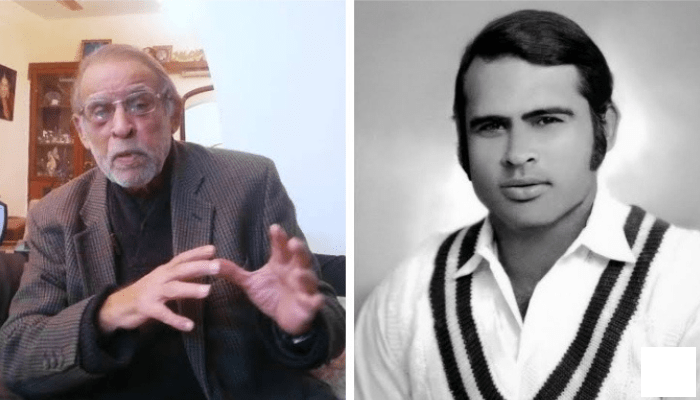
With the demise o Mohammad Ilyas, Pakistan cricket lost a healthy critic of the game
Special Correspondent
Former Pakistan Test opener and ex-chief selector Mohammad Ilyas passed away in Lahore on Monday after a prolonged illness. He was 79. A cricketer of rare individuality, Ilyas leaves behind a legacy that stretches far beyond scorebooks, shaped by talent, controversy, resilience and an enduring passion for the game.
Fondly — and somewhat intriguingly — known as “John” among friends and teammates, Mohammad Ilyas belonged to a generation that played international cricket during a challenging phase of Pakistan’s early Test history. Though his international career was relatively brief, his life in cricket was long, eventful and deeply intertwined with the sport at multiple levels.
From boxing gloves to cricket whites
Born and raised in Lahore, Ilyas’ first sporting love was not cricket but boxing. As a schoolboy, he showed promise as a flyweight boxer and enjoyed success at the school level. Fate, however, had other plans.
He drifted into cricket through casual games near his home, initially as a fast bowler. A perceptive teacher at Muslim Model School — a renowned nursery of cricketing talent in the 1950s — spotted his potential and invited him to train in the school nets. That moment proved decisive.
In his very first outing for a Lahore schools’ side in Faisalabad, Ilyas impressed with the ball and then, sent in as a nightwatchman, surprised everyone by scoring a fluent half-century. Though he briefly experimented with leg-spin bowling, it soon became clear that his future lay at the top of the order as an attacking batter.
Rise through Lahore’s cricketing circles
Ilyas progressed rapidly through Lahore’s vibrant school and club cricket system, representing the famous Crescent Club, one of the city’s oldest and strongest institutions. His composure and fearless stroke play set him apart at a very young age.
In November 1961, at just 15, he made his first-class debut for a Lahore B side in the Quaid-e-Azam Trophy. He marked the occasion with a wicket and an unbeaten 15, though the spotlight that day fell on another teenage debutant — Majid Khan, who announced himself with a century and six wickets.
Over the next three years, Ilyas scored three first-class centuries, including a notable hundred in a warm-up match against Queensland, performances that pushed him into national contention.
Test career and a memorable century
Mohammad Ilyas made his Test debut against Australia at the Melbourne Cricket Ground on 4 December 1964, sharing debut honours with Australia’s Ian Chappell. Known for his aggressive mindset and strong hook shot, Ilyas impressed on tour and followed up with another century against South Australia.
Between 1964 and 1969, he played 10 Test matches for Pakistan, six of them against New Zealand. His finest hour came in Karachi in 1965, when he scored a superb 126 while opening the batting in the third Test against New Zealand. Pakistan successfully chased a target of 202, sealing a historic 2-0 series victory, with Ilyas’ innings standing as the cornerstone of the win.
Despite flashes of brilliance, his Test career never fully flourished, reflecting the instability and transitional nature of Pakistan cricket during that era. His final Test appearance came against England in Dhaka in early 1969.
A sudden and controversial exit
Ilyas remained part of Pakistan’s wider squad into the early 1970s and toured Australia and New Zealand in 1972-73. That tour, however, marked a dramatic turning point.
Following an alleged physical altercation with Abdul Hafeez Kardar, then head of the BCCP and the most powerful figure in Pakistan cricket, Ilyas was dropped from the squad. Rather than returning home, he chose to stay back in Australia, playing grade cricket in Sydney, including for Waverley.
He would play only one more first-class match after that episode, ending his professional playing career quietly — with a duck.
A life lived across continents
After international cricket, Ilyas led a nomadic cricketing life. He played league cricket in Scotland, appeared in matches in Rhodesia (now Zimbabwe) and spent time settled in England before eventually returning to Pakistan.
In the 2000s, he re-entered the national cricket framework as a member of various selection committees, including a stint as chief selector. His administrative career, much like his playing days, was marked by outspoken views and frequent controversy.
He often made headlines — for disputes with fellow selectors, public disagreements with players, including Shahid Afridi, and legal action against the PCB after his removal as a junior selector in 2014. Despite the turbulence, his commitment to cricket never waned.
Numbers and legacy
In total, Mohammad Ilyas played:
- 10 Test matches
- 82 first-class matches
- 2 List-A games
He scored 4,607 first-class runs, including 12 centuries, at an average of 35.71 — statistics that only partially capture his impact.
More than numbers, Ilyas will be remembered as a free spirit of Pakistan cricket — a player who challenged conventions, lived intensely and remained fiercely attached to the game throughout his life.
Tributes from PCB
The Pakistan Cricket Board (PCB) expressed deep sorrow over his passing. PCB Chairman Mohsin Naqvi extended heartfelt condolences to the bereaved family and paid tribute to Ilyas for his services to Pakistan cricket, acknowledging his contributions both as a player and as a selector.
With his passing, Pakistan cricket bids farewell to a figure who embodied both the romance and the rough edges of the game’s formative decades — a cricketer whose life story mirrors the complex, passionate journey of Pakistan cricket itself.




