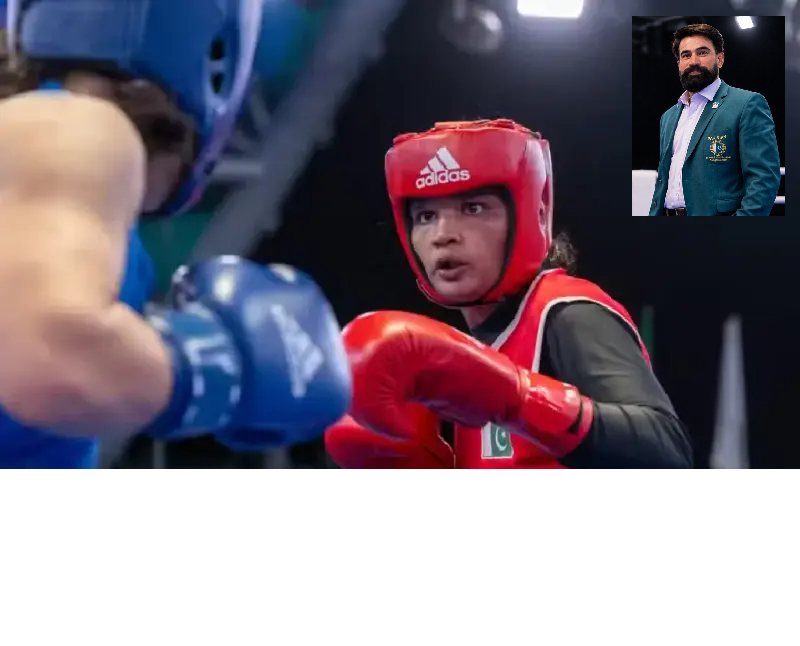
At just 19, the Sargodha-born pugilist became Pakistan’s first-ever female boxing medalist at a major international multi-sport event. Now she has her sights set on Olympic qualification
The female boxer explains her journey to her historic bronze, army discipline, and breaking barriers for Pakistani girls
Asher Butt
The name Fatima Zehra does not yet echo through stadiums the way it should. But it will. At 19 years old, standing just 158 centimetres tall, the boxer from Sargodha has already done what no Pakistani woman has done before her: she climbed an international podium, medal around her neck, flag behind her, history beneath her feet.
The occasion was the 6th Islamic Solidarity Games in Riyadh, November 2025. The weight class was 60 kilograms. The opponent in the quarterfinal was Algeria’s Hamda Melissa, dispatched with a clinical 5-0 decision. The semifinal brought defeat, but also bronze—Pakistan’s first-ever women’s boxing medal at a major international multi-sport event. For a country where female boxers were once counted in the dozens, where training facilities could be counted on one hand, and where societal permission often had to be negotiated family by family, this was not merely a medal. It was a crack in a very old ceiling.
Fatima Zehra, known affectionately in boxing circles as the “Honey Boxer,” is now the face of a movement. Eight-time national champion. Two-time National Games gold medalist. Pakistan Army athlete. And now, history-maker.
The coach behind the champion: Raheel’s unwavering faith
None of this would have been possible without the man who saw potential before the medals arrived. Raheel, Fatima’s coach, has been the architect of her rise—the steady hand behind the rapid jabs, the voice that cut through self-doubt, the strategist who transformed raw talent into international pedigree. When Fatima speaks of her journey, she speaks of him in the same breath as her own dreams. “My coach worked very hard,” she says simply. But that simple sentence carries the weight of years: early morning sessions, grueling sparring, tactical breakdowns, and the quiet belief that a teenage girl from Sargodha could stand on a podium in Riyadh.
Raheel’s coaching philosophy blends technical precision with psychological resilience. He understood that Fatima’s greatest weapon was not her power—though she has 10 career knockouts—but her adaptability. Under his guidance, she, the product of Punjab boxing, has competed in both featherweight (57kg) and lightweight (60kg) divisions, managing weight cuts with military discipline while maintaining the ring strength that has made her unbeaten in domestic finals since 2021. He has drilled into her the lessons learned at the Asian Games in Hangzhou: better footwork, tighter defense, and the calm execution of strategy under international pressure. For Raheel, Fatima’s bronze medal is not the destination. It is the validation of a method. And with Olympic qualification now the target, his work has only just begun.
Breaking barriers, one round at a time
How does it feel to know your name is permanently etched in history as Pakistan’s first-ever female international boxing medalist?
Fatima Zehra: I had a dream that I would win a medal for Pakistan, and I fulfilled that dream. Behind this, my coach worked very hard. I am very grateful to him for the effort he put into me and for making me capable of achieving this.
When you stood on the podium at the Islamic Solidarity Games, what thoughts and emotions were running through your mind?
Fatima Zehra: This was the happiest moment of my life. Tears of joy in my eyes were proof that my hard work had paid off. I feel proud of myself for winning a medal for Pakistan and for making history.
Boxing is traditionally viewed as a male-dominated sport in Pakistan. What was the initial reaction from your family and peers when you chose this path?
Fatima Zehra: Boxing isn’t just a men’s sport—it’s very popular among women too. With safety gear like head guards, it’s not so dangerous that girls can’t do it. My dad was also a sportsman, so he supported me a lot, and that’s why I chose this sport.
You represent the Pakistan Army domestically. How has the discipline and structure of the Army helped shape your boxing career?
Fatima Zehra: I am very grateful to the Pakistan Army for supporting me and sponsoring me at events.
As an eight-time National Champion, how do you stay motivated to maintain your domestic dominance year after year?
Fatima Zehra: I stay motivated by remembering my dream of winning a medal for Pakistan and making history. My coach’s hard work and my goal to break barriers for women in boxing push me to get stronger, faster, and better each season.
You recently won gold at the 2025 National Games and were honored as a “Hamaray Hero” at the PSL in 2026. How does this national recognition impact your drive for future success?
Fatima Zehra: It means the world to me. It shows that Pakistan believes in me and pushes me to work even harder. With my coach’s guidance, I feel proud and more determined to keep making history and bring more glory to my country.
You are called “Honey Boxer.” How was it named?
Fatima Zehra: My family has been calling me Honey since childhood. When I entered boxing, everyone started calling me Honey Boxer.
You have competed in both featherweight (57kg) and lightweight (60kg) divisions. How difficult is it to manage weight cuts while maintaining ring strength?
Fatima Zehra: It’s challenging and takes strict discipline, proper nutrition, and my coach’s training plan. I focus on staying strong and fast, training smart to perform my best at either weight.
What does a typical high-intensity training day look like for you when preparing for an international tournament?
Fatima Zehra: I start with running and conditioning, then do intense boxing drills with my coach, followed by strength and core work, and end with recovery and strategy review.
What major technical lessons did you take away from your international debut at the Asian Games in Hangzhou?
Fatima Zehra: I learned to improve footwork, ring control, and defense against faster opponents, and that staying calm and sticking to my coach’s strategy is key at the international level.
What specific goals have you set for yourself regarding the next Olympic qualification cycle?
Fatima Zehra: My goal is to train harder with my coach, improve my speed and technique, compete in more international tournaments, and qualify to represent Pakistan at the Olympics.
What infrastructure or support is most urgently needed to help more young Pakistani girls enter boxing?
Fatima Zehra: More training centers, female coaches, proper gear, and family and community support.
What is the ultimate message you want to send to young girls watching you from Sargodha and across Pakistan?
Fatima Zehra: Believe in yourself, work hard, and never let anyone stop you from chasing your dreams—you can achieve anything in boxing or any field.
At 19, Fatima Zehra has already accomplished what most athletes spend entire careers chasing. But she is not satisfied. The Olympic rings remain the ultimate target, and with the next qualification cycle approaching, she and Coach Raheel are already deep in preparation. The Army facilities in Karachi buzz with her footwork. The sparring rounds with male boxers continue to sharpen her reflexes. And the dream—the one she had as a girl in Sargodha—has only grown larger.
She is the Honey Boxer. And she is not done making history.
- the writer is a Lahore-based journalist covering all sports including boxing, cricket, and Pakistan’s emerging sporting talent for the last three decades now.