
Special Correspondent
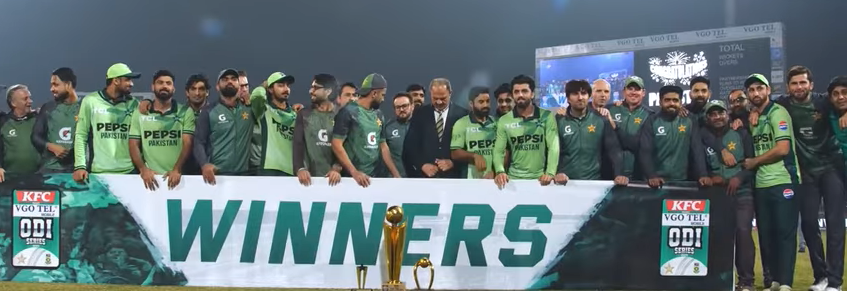
Pakistan’s seven-wicket victory in the third ODI at Faisalabad’s Iqbal Stadium concluded a compelling three-match series against South Africa with a 2-1 scoreline, marking the hosts’ first-ever home ODI series triumph over the Proteas. Under Shaheen Shah Afridi’s captaincy, the team demonstrated strength and tactical acumen across formats, having already secured a T20I series victory and drawn the Test series during South Africa’s comprehensive tour. However, beneath the celebratory surface lies a performance that revealed both encouraging developments and persistent vulnerabilities that demand attention.
Positives emergence of stars and strategic depth
The series showcased Pakistan’s most significant positive: the emergence of Saim Ayub as a genuine match-winner. The young left-hander’s maturity belied his inexperience, culminating in a player-of-the-match performance with 77 runs off 70 balls in the decisive encounter. His ability to construct innings under pressure, evidenced by half-centuries in both the second and third ODIs, adds crucial depth to Pakistan’s top order. Ayub’s strokeplay combined classical technique with modern aggression, particularly his willingness to take aerial routes while maintaining composure during challenging phases.
Abrar Ahmed’s return proved transformative in the final match. His career-best figures of 4 for 27 demonstrated the value of skilled spin bowling in home conditions. Abrar’s ability to extract turn and utilize variations effectively dismantled South Africa’s middle order, triggering a catastrophic collapse from 106 for 2 to 143 all out. His emphasis on simplicity and communication with wicketkeeper Mohammad Rizwan highlighted tactical maturity that Pakistan can leverage in subcontinental conditions.
The middle-order contributions deserve recognition despite inconsistencies. Salman Ali Agha’s two half-centuries across the series—68 in the second ODI and 62 in the first—provided stability during crisis moments. Mohammad Nawaz’s counter-attacking 59 in the second match demonstrated valuable lower-middle-order firepower, while Mohammad Rizwan’s 55 in the opening encounter showcased his ability to anchor chases effectively.
Pakistan’s bowling attack displayed commendable versatility. Naseem Shah’s disciplined spell of 3 for 40 in the first ODI broke crucial partnerships, while Shaheen Afridi’s leadership from the front combined tactical shrewdness with crucial breakthroughs. The captain’s willingness to utilize unconventional options like Ayub’s part-time spin and Agha’s off-breaks yielded dividends, suggesting tactical flexibility that can trouble opponents.
Negatives see fragility and familiar failures
Despite victory, Pakistan’s batting frailties remain alarmingly persistent. The middle-order collapse in the opening match nearly squandered a comfortable chase, with the team stumbling from 241 for 5 to requiring last-over heroics. This pattern of anxiety during seemingly straightforward run-chases reflects mental fragility that could prove costly against stronger opposition.
Fakhar Zaman’s consecutive ducks in the second and third ODIs exposed vulnerability at the top. His dismissals—both caught behind off Nandre Burger—revealed technical deficiencies against quality seam bowling. The inability to provide consistent opening partnerships, barring the first match’s 87-run stand, placed excessive pressure on the middle order.
Babar Azam’s underwhelming series—scoring just 11, 7, and 27—raises concerns about Pakistan’s premier batsman. Despite reaching the milestone of 15,000 international runs, his struggles against both pace and spin suggest timing issues that need immediate rectification. The run-out in the final match exemplified poor decision-making under minimal pressure.
Pakistan’s second ODI performance exposed systemic batting weaknesses. The collapse to 22 for 3 within five overs and the subsequent inability to accelerate—Ayub and Agha striking at 80.30 and 65.09 respectively—demonstrated a concerning lack of intent. Posting merely 269 on what appeared a decent batting surface indicated risk-aversion that limits Pakistan’s potential.
The death bowling remains problematic. Conceding 90 runs in the final ten overs during the second ODI, including 22 off Nqabayomzi Peter’s last over, highlighted execution failures under pressure. While Pakistan’s total proved insufficient, the inability to restrict South Africa’s lower order undermined earlier good work.
Strategic observations and tactical insights
Afridi’s captaincy debut showcased promising tactical flexibility. His willingness to rotate bowlers—using eight options in the second ODI—and introduce surprise elements like Ayub’s bowling demonstrated adaptability. However, field placements occasionally appeared defensive when aggression might have yielded breakthroughs, particularly during South Africa’s second ODI chase where de Kock and de Zorzi accumulated runs with relative ease.
The decision to rest Naseem Shah and Mohammad Wasim Jr. for the final encounter proved inspired, with Abrar Ahmed and Haris Rauf’s returns providing fresh impetus. This rotation policy acknowledges workload management while maintaining competitive intensity—a approach essential for Pakistan’s congested international schedule.
South Africa’s struggles against spin bowling—losing all ten wickets for 71 runs after reaching 72 without loss in the third ODI—validated Pakistan’s home advantage utilization. The slow, low Faisalabad pitch favored spinners, and Pakistan’s preparation and selection reflected shrewd planning.
Recommendations for sustained success
Pakistan must address batting consistency urgently. Fakhar Zaman requires technical adjustments against quality seam bowling, potentially working on his trigger movements and initial foot positioning. Alternative opening options should be explored in domestic cricket to provide depth and competition.
Babar Azam needs match time in pressure-free environments to rediscover timing and confidence. His class remains undeniable, but form requires nurturing rather than expectation. The management should consider brief rest periods to prevent mental fatigue.
Middle-order intent requires cultural shift. Pakistan’s batsmen must develop the ability to score at 90-100 strike rates consistently in favorable conditions, rather than defaulting to conservative accumulation. Aggressive intent training through scenario-based practice matches could address this conservatism.
Death bowling execution demands intensive skills work. Yorker practice, slower ball variations, and pressure simulation should feature prominently in training. Dedicated death-bowling specialists need identification and development.
The spin-bowling department, despite Abrar’s success, needs depth beyond primary options. Developing additional quality spinners ensures Pakistan isn’t over-reliant on individuals, particularly given Abrar’s recent suspension issues.
Final word
Pakistan’s series victory represents meaningful progress, particularly the emergence of Ayub and tactical flexibility under new leadership. However, persistent batting fragilities and execution lapses prevent this from being an unqualified success. The margin between victory and defeat remained perilously thin across all three matches, suggesting Pakistan remains a team of moments rather than sustained excellence.
The positive atmosphere at Faisalabad, with packed crowds witnessing international cricket’s return, provides intangible benefits that shouldn’t be underestimated. Home advantage proved decisive, but Pakistan must translate these performances into away success for genuine world-class credentials.
As Afridi noted, teamwork delivered this series, but individual accountability for technical and tactical improvements remains essential. The challenge ahead involves converting potential into consistent performance, transforming narrow victories into commanding displays, and ensuring the next assignment builds upon rather than exposes the foundations laid in Faisalabad.




