Pakistan’s lovebird community unites: 200 elite breeders pledge new era of positivity in aviculture
Historic gathering marks turning point for nation’s thriving bird breeding industry
Special Correspondent
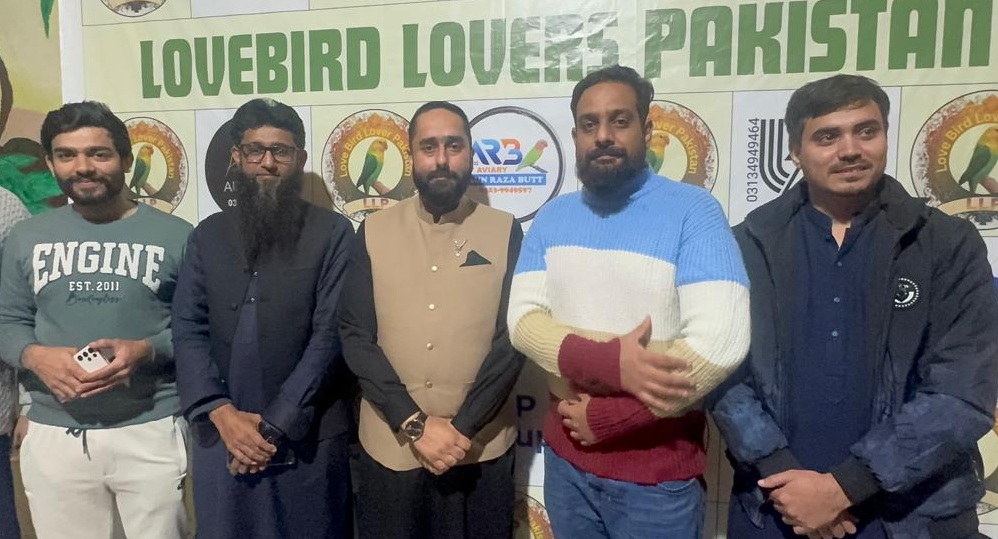
In a powerful display of unity and shared purpose, approximately 200 of Pakistan’s most prominent lovebird fanciers, breeders, and traders gathered recently to chart a bold new course for the country’s aviculture industry. The landmark event, jointly organized by Lovebirds Lovers of Pakistan (LLP) and Pale Fellow Lovers (PLF) in collaboration with NS Aviary, represented far more than a routine meeting—it was a collective commitment to elevate Pakistan’s standing in the global bird breeding community while fostering an environment of collaboration over competition.
Held at NS Aviary, owned and operated by renowned breeder Naveed Sheikh, the gathering brought together voices from across Pakistan’s diverse aviculture landscape—from seasoned exporters and commercial breeders to passionate hobbyists and veterinary professionals. What united this eclectic assembly was a shared love for one of nature’s most captivating creatures, the lovebird, and a determination to overcome the negativity and division that has occasionally plagued the industry.
The vision: Three pillars, one community
Naveed Sheikh, widely regarded as “the birdman of Pakistan,” set the gathering’s tone with a pragmatic yet inspiring address that acknowledged the diverse motivations driving people to aviculture while emphasizing their common ground.
“There are three types of breeders,” Sheikh explained, “traders who breed birds as their primary business, hobbyists who pursue aviculture for personal passion and enjoyment, and those who’ve adopted bird breeding as a supplementary income source alongside other professions.”
Rather than seeing these different approaches as competing interests, Sheikh stressed that all three categories possess equal legitimacy and importance to the industry’s health. “Whoever is breeding birds—as a business, as a hobby, or for secondary income—must share success stories on social media and actively work to eliminate negativity from our community.”
This call for positive engagement on digital platforms reflected a broader understanding among attendees that modern aviculture cannot thrive in isolation. Social media has become simultaneously an opportunity for education, marketing, and community building, as well as a platform where misinformation and negative narratives can spread quickly if left unchecked.
Sheikh’s message carried particular weight given his stature in Pakistan’s aviculture circles. His emphasis on mentorship and responsibility resonated throughout the event: “We as senior fanciers must develop trust among common people and new hobbyists to attract them to this field. Everyone must understand that we’re all here under one roof because of a small creature—the lovebirds—despite awkward weather conditions. We must respect our fellow aviculturists.”
This seemingly simple observation—that hundreds of people would gather in uncomfortable conditions purely out of devotion to these feathered companions—underscored the genuine passion binding the community together, a foundation strong enough to support the ambitious goals articulated throughout the day.
Strength in numbers: The bundle of sticks philosophy
Rana Jibran, one of the event’s key organizers, employed a powerful metaphor to illustrate the strategic importance of unity. Drawing on the ancient fable of the bundle of sticks, Jibran reminded attendees that individual sticks break easily, but bound together, they become nearly impossible to fracture.
“Together we will strengthen the field of aviculture,” Jibran declared. “Opportunists and fair-weather friends have left the field during difficult times. Now is the moment to rebuild trust and recognize that without lovebirds, aviculture itself is doomed. Lovebirds are the pillar supporting everything we do.”
This frank acknowledgment that Pakistan’s aviculture industry had weathered difficult periods—when less committed participants abandoned the field—served as both validation for those who persevered and a rallying cry for renewed commitment. The economic challenges of recent years, including the global COVID-19 pandemic’s economic fallout and Pakistan’s domestic economic pressures, had tested the resolve of everyone involved in what remains a relatively niche industry.
Jibran’s emphasis on lovebirds as the “pillar of aviculture” reflected practical reality. While Pakistan’s bird breeding community encompasses various species, lovebirds have emerged as the most commercially viable, internationally recognized, and accessible entry point for new hobbyists. Their relatively manageable care requirements, stunning color variations through selective breeding, and strong international demand have positioned lovebirds at the center of Pakistan’s aviculture export economy.
Economic resilience: Aviculture as financial lifeline
The gathering featured multiple testimonials from breeders who’ve discovered that lovebird breeding offers not just passion and purpose, but genuine economic sustainability—sometimes serving as a crucial financial lifeline when other ventures faltered.
Haris Raees, affectionately known as “baba-e-lovebirds” (father of lovebirds) within the community, spoke to the unique dignity and opportunity the profession offers. “I have not seen any respectable business better than aviculture,” Raees proclaimed. “It is a profession that allows you to earn money from your own home.”
This observation carries particular significance in Pakistan’s economic context, where formal employment opportunities can be limited, commuting costs are substantial, and many people—particularly women—face barriers to participating in traditional workplace environments. Aviculture offers an alternative: a home-based business model that requires relatively modest initial investment, utilizes existing residential space, and can scale according to the breeder’s resources and ambitions.
Sheikh Haneef, founder of one of Pakistan’s prominent lovebird societies, provided a compelling personal testament to aviculture’s economic resilience. Haneef had built a successful property business that “faced disaster since COVID-19 hit the globe,” with subsequent influxes of taxes further deteriorating the sector. “But it was the lovebirds business that kept me flourishing,” Haneef explained.
His declaration that “lovebirds are the engine of aviculture” wasn’t merely poetic—it reflected lived experience of financial survival and recovery through bird breeding when his primary business collapsed. This narrative likely resonated with many attendees who’ve experienced similar economic volatility in recent years.
However, Haneef didn’t shy away from acknowledging the cultural and interpersonal challenges that have hindered the industry’s potential. “Negativity, jealousy, and nepotism are the main reasons for aviculture’s downfall,” he stated bluntly, pleading for genuine togetherness that transcends individual egos and competitive jealousies.
Looking forward: Innovation and international recognition
Raheem Dhillon of Dhillon Aviary brought a forward-looking perspective to the gathering, calling all fanciers “stars of aviculture” while sharing his personal vision of spending retirement surrounded by birds—a testament to the lifelong commitment many feel toward the hobby.
“The time of decline has passed,” Dhillon asserted confidently. “We all need to move forward with trends and bring new novelty to the lovebirds field.”
This emphasis on innovation and trend awareness reflected a mature understanding that Pakistan’s aviculture industry cannot rest on past achievements. International markets constantly evolve, new color mutations emerge through selective breeding programs worldwide, and consumer preferences shift. Pakistani breeders must remain at the forefront of these developments to maintain and expand their international market position.
Hanzala Shareef of Birds Shed Hanzala provided perhaps the gathering’s most striking claim about Pakistan’s rise in global aviculture rankings. “We have come this far after a rough, long journey and have left behind even the top breeders of lovebirds in China, Thailand, and Indonesia, who now fancy our breeds and mutations,” Shareef proclaimed.
This assertion—that Pakistani breeders have surpassed traditionally dominant Asian competitors to the point where Chinese, Thai, and Indonesian fanciers now seek Pakistani-bred birds—represents a remarkable reversal if accurate. China, Thailand, and Indonesia have long been recognized as powerhouses in ornamental bird breeding, with established export markets, advanced breeding techniques, and supportive regulatory frameworks.
Shareef credited this achievement to Pakistan’s breeding community’s dedication and perseverance, while also highlighting crucial infrastructure development: “The necessity of DNA lab services during this journey cannot be overstated.”
Access to genetic testing laboratories allows Pakistani breeders to sex birds accurately (critical for breeding pairs), verify genetic lineages, and develop new color mutations with scientific precision rather than trial-and-error. This technical sophistication distinguishes professional breeding operations from backyard hobbyists and has been instrumental in Pakistan’s quality improvements.
However, Shareef tempered his celebration of achievement with cautionary advice: “We must avoid being egotistic, stop pulling each other down, and move forward while making full use of social media for aviculture promotion.”
This recurring theme—that interpersonal dynamics and community culture matter as much as breeding expertise—underscored a collective recognition that Pakistan’s aviculture industry’s greatest obstacles may be internal rather than external.
The role of science and expertise
Dr. Furqan, representing the DNA laboratory services that have become integral to professional breeding operations, emphasized the critical importance of organizing gatherings like this one. “Events like these build community connections that strengthen the entire industry,” Dr. Furqan noted, while stressing that social media platforms serve as primary promotional channels in the modern era.
The presence and prominence of veterinary and genetic testing professionals at the gathering reflected aviculture’s evolution from informal backyard hobby to professionalized industry. Today’s successful breeders increasingly rely on scientific services—DNA sexing, disease diagnosis, nutritional consultation, and genetic counseling—that barely existed in Pakistan’s aviculture sector a decade ago.
Dr. Shamsa Hashami, known as “the Bird Lady of Pakistan,” brought particular credibility to discussions of proper bird care and welfare. As one of relatively few women with high public profiles in Pakistan’s aviculture community, Dr. Hashami’s presence also symbolized the industry’s gradual—if incomplete—movement toward greater inclusivity.
Dr. Hashami highlighted the educational value of community gatherings: “Events like these are invaluable for learning proper lovebird care techniques and staying current with best practices.” She echoed the recurring emphasis on social media engagement as “a necessity of our time,” recognizing that younger generations of potential hobbyists discover and engage with aviculture primarily through digital platforms.
International success and quality focus
Mirza Atif Baig, identified as one of Pakistan’s top lovebird exporters, provided a bird’s-eye view of the industry’s international trajectory. “The progress Pakistan has achieved locally, across borders, and internationally for mutation development is now recognized globally,” Baig reported.
This international recognition carries enormous commercial significance. When foreign buyers and breeders acknowledge Pakistani lovebirds as high-quality specimens worthy of import for their own breeding programs, it validates years of selective breeding work and opens premium market segments.
However, Baig cautioned against complacency: “We must continue working on quality breeding.” This emphasis on quality over quantity reflected awareness that Pakistan’s reputation—painstakingly built over years—could be quickly damaged by breeders prioritizing short-term profits through mass production of inferior birds.
The export market’s importance to Pakistan’s aviculture industry cannot be overstated. While domestic demand exists, international buyers—particularly in Middle Eastern countries, parts of Europe, and other Asian markets—typically pay premium prices for rare color mutations and high-quality breeding stock. Export earnings also provide foreign exchange, a consideration of particular importance given Pakistan’s chronic foreign currency challenges.
Spreading the movement: Regional organization
A fancier from Faisalabad (Pakistan’s third-largest city) articulated the gathering’s implicit goal: expanding the unity movement beyond Lahore to Pakistan’s other major cities and regional centers. “The voice of togetherness and unity among us should be heard across the country,” he urged. “Make positivity a trend and organize similar gatherings in your circles for lovebird promotion.”
This call for regional replication recognized that Pakistan’s aviculture community remains geographically dispersed, with significant concentrations of breeders in Lahore, Karachi, Islamabad, Faisalabad, and other urban centers. While social media enables virtual connection, periodic in-person gatherings serve irreplaceable functions: building personal relationships, facilitating direct knowledge transfer, enabling birds and equipment trading, and creating the emotional bonds that transform collections of individuals into genuine communities.
The Faisalabad fancier’s emphasis on “making positivity a trend” acknowledged a harsh reality: negativity, criticism, and interpersonal conflicts have historically attracted attention and engagement on social media platforms, sometimes overshadowing constructive content. Consciously cultivating and amplifying positive narratives requires sustained, intentional effort from community leaders and influential voices.
Recognition and gratitude: The team behind the vision
The gathering concluded with distribution of participation certificates to newer and emerging fanciers—a symbolic gesture acknowledging their commitment to the community and welcoming them into the broader aviculture family.
Event organizers took care to publicly recognize the extensive team whose efforts made the gathering possible. Key contributors included Rana Jibran, Nasir Younus, Aun Raza Butt, Almas Sheikh, Ali Attar, Mohammad Hafeez, Sheikh Ahmad, Nasir Iqbal, Mazhar Ali Faridi, Shahyar Naeem, Fahad Zia, and Saif Ur Rehman—a roster reflecting the diverse talents and connections required to coordinate such a large-scale community event.
Supporting organizations provided crucial institutional backing: Birds Genetic Centre, HS Labs, Agapornis Club of Pakistan, and Lovebirds Society of Pakistan. These entities represent different facets of Pakistan’s aviculture ecosystem—commercial services, scientific infrastructure, and hobbyist associations—coming together in support of shared goals.
The explicit recognition of both individuals and organizations served important functions beyond simple courtesy. It modeled the collaborative ethos the gathering championed, demonstrated that significant achievements require collective effort, and provided a roadmap for others seeking to organize similar events in their regions.
The path forward: Challenges and opportunities
While the gathering radiated optimism and determination, the recurring emphasis on overcoming “negativity,” “jealousy,” and “leg-pulling” revealed an undercurrent of frustration with interpersonal dynamics that have hindered the community’s potential.
These challenges are hardly unique to Pakistan’s aviculture industry. Any community built around passionate hobby or specialized knowledge tends to develop internal tensions: competitive jealousies between breeders, disputes over proper techniques or ethical standards, personality conflicts amplified by social media, and gatekeeping behaviors that exclude newcomers. The Pakistani aviculture community’s willingness to confront these issues openly, rather than pretending they don’t exist, suggests genuine commitment to cultural transformation.
The path forward outlined at the gathering rests on several interconnected pillars:
Unity and collaboration: Moving beyond individual competition to recognize shared interests in industry growth and reputation enhancement.
Positive Digital Presence: Leveraging social media platforms to share success stories, educate newcomers, and counteract misinformation rather than engaging in public disputes.
Scientific professionalism: Continued investment in genetic testing, veterinary care, and evidence-based breeding practices that distinguish Pakistani breeders from less sophisticated competitors.
Quality focus: Resisting temptations toward mass production and maintaining breeding standards that justify premium pricing in international markets.
Inclusive growth: Welcoming and mentoring new hobbyists rather than treating them as competitors, recognizing that industry expansion benefits all participants.
Regional expansion: replicating the gathering’s model in other pakistani cities to build nationwide cohesion and shared purpose.
international engagement: Continuing to develop mutations and breeding lines that attract global attention and maintain Pakistan’s rising reputation.
Conclusion: A small bird with Bi|g implications
The gathering of 200 lovebird enthusiasts might seem, at first glance, a niche event of limited broader significance. Yet it represents something considerably larger: a community of Pakistanis finding economic opportunity, personal fulfillment, and international recognition in an industry that barely existed in organized form two decades ago.
Pakistan’s broader economic narrative often focuses on traditional sectors—textiles, agriculture, construction—or emerging digital economy segments. Aviculture rarely receives attention in economic planning or policy discussions. Yet here exists a thriving industry generating export earnings, providing home-based income opportunities, and placing Pakistan on the global map in a specialized field.
The lovebirds themselves—small parrots native to Africa but now bred in countless color variations worldwide—have become unlikely ambassadors for Pakistani expertise and dedication. When breeders in China, Thailand, and Indonesia seek Pakistani-bred birds, they validate not just individual breeders’ skills but the collective achievements of Pakistan’s aviculture community.
The gathering’s emphasis on unity, positivity, and professionalism reflects maturity and ambition. These breeders aren’t content with local success or modest operations. They aspire to maintain and expand Pakistan’s position among global aviculture leaders, and they recognize that achieving this requires overcoming internal divisions and presenting a united, professional face to the world.
As certificates were distributed to new fanciers and attendees departed NS Aviary, they carried with them a renewed sense of purpose and community. The challenges ahead remain significant—economic volatility, regulatory uncertainties, international competition, and the persistent interpersonal tensions that any passionate community must navigate.
Yet the very fact that 200 busy people gathered “despite awkward weather conditions” to discuss birds, share knowledge, and commit to collective progress demonstrates the remarkable power of shared passion. In the intricate patterns of a lovebird’s plumage, Pakistani breeders have found not just beauty, but opportunity, community, and a path toward international recognition.
The new era of positivity pledged at this gathering will be tested in coming months and years. Success will be measured not just in export statistics or social media engagement metrics, but in whether the Pakistani aviculture community can sustain the collaborative spirit and professional standards it aspires to. The lovebirds—small creatures that brought hundreds together under one roof—will continue serving as both inspiration and test of whether passion can indeed build lasting industry and community.
For now, Pakistan’s lovebird breeders have sent a clear message: they’re united, they’re professional, and they’re determined to write the next chapter in their industry’s remarkable rise. The world’s aviculture community would be wise to pay attention.