
It is how a Pakistani entrepreneur’s football conquered the World Cup—and the Universe
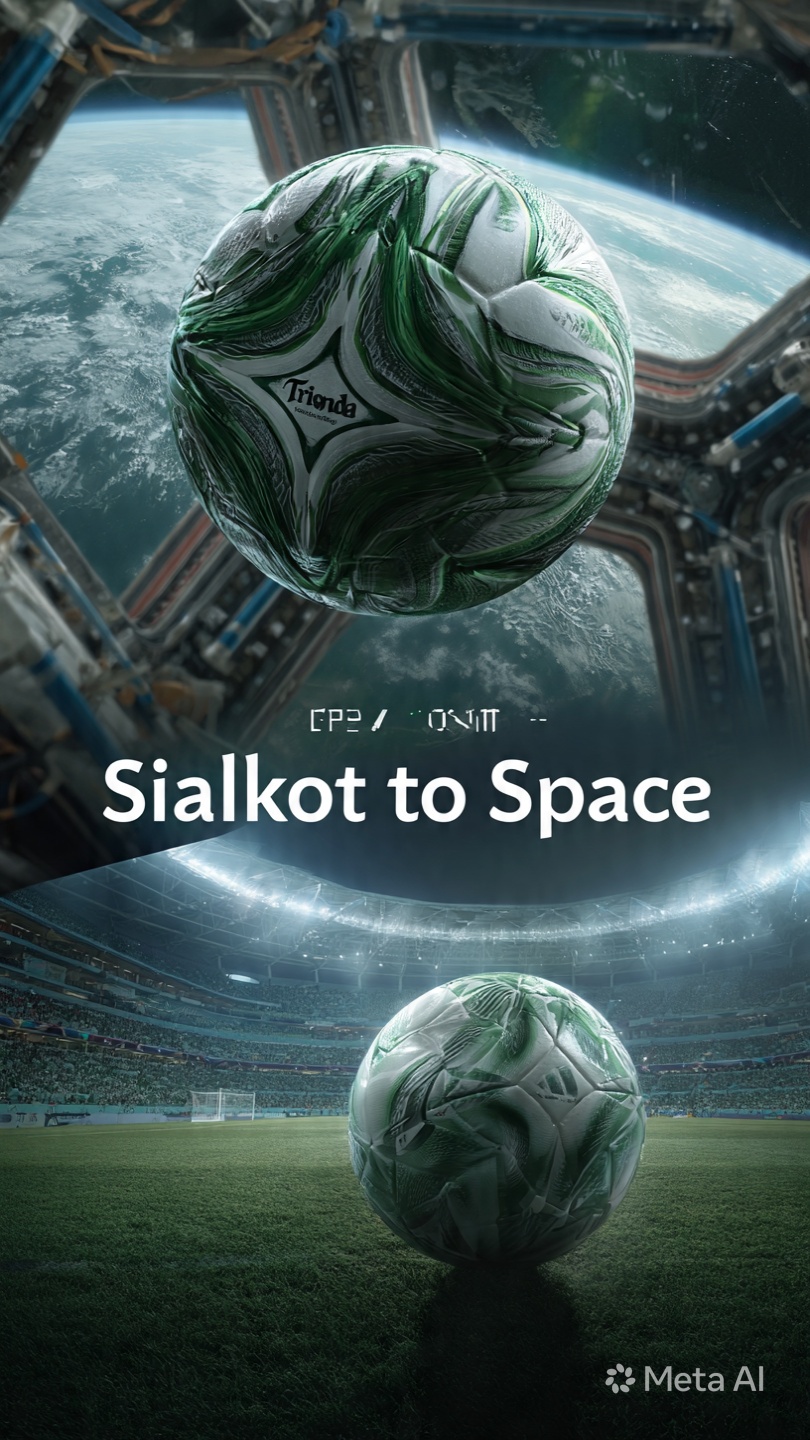
Every goal at FIFA World Cup 2026 is being scored with a ball made in Pakistan. Now, that same ball has floated aboard the International Space Station.
Asher Butt
In the sweltering heat of a Sialkot workshop in 1991, Khawaja Masood Akhtar sat in a single room with just 20 employees and a dream that seemed impossibly ambitious. The former civil engineer with Pakistan Railways had left the security of his job to join his uncle’s sports goods business, though he admits, “I never imagined I would end up manufacturing footballs.”
Thirty-five years later, every single goal at the FIFA World Cup 2026 is being scored with a football bearing the mark of his company, Forward Sports Private Limited. And in a twist that reads like fiction, that same Pakistani-made football has even journeyed beyond Earth, floating weightlessly aboard the International Space Station during a NASA experiment.
This is the extraordinary story of how a city in Pakistan became the invisible heartbeat of the world’s most watched sporting event.
The football capital you’ve never heard of
While fans in stadiums across the United States, Canada, and Mexico roar with every goal, few realize that the ball at their feet has traveled thousands of miles from Sialkot, Pakistan—a city that quietly produces nearly 70% of the world’s footballs.
Every year, approximately 40 million footballs roll off assembly lines in this industrial hub, with hundreds of thousands shipped daily to every corner of the globe. For decades, Sialkot’s master craftsmen have shaped the beautiful game from behind the scenes, their hands stitching together the dreams of nations.
Yet Pakistan’s national football team has never qualified for a World Cup. This creates one of sport’s most poignant ironies: a nation absent from the pitch, yet present in every match.
The Adidas breakthrough that changed everything
The turning point in Khawaja Masood Akhtar’s journey came in 1994, when Adidas partnered with Forward Sports. That handshake opened doors to international recognition and eventually, the holy grail of football manufacturing: FIFA World Cup contracts.
Since then, Forward Sports has supplied official match balls for the 2014, 2018, 2022, and now 2026 World Cups. The company has evolved dramatically—from hand-stitched leather spheres to cutting-edge thermo-bonded and machine-stitched technology that meets FIFA’s exacting standards.
Each football design cycle takes several years of research and development. Modern automation has slashed production time while elevating quality and consistency to levels that would have been unimaginable in that single Sialkot room three decades ago.
The women behind the world’s game
Walk through Forward Sports’ facilities today, and you’ll discover another remarkable story: women are the backbone of this operation.
A large portion of the workforce consists of women who handle stitching, quality control, and finishing processes—the critical final touches that ensure every ball meets world-class standards. Recognizing their indispensable contribution, the company has introduced transport and healthcare facilities specifically to support female workers and increase participation.
Management is unequivocal: without these women, global quality standards would be impossible to maintain. In a country where female workforce participation faces numerous challenges, Forward Sports has become a beacon of progressive employment practices.
From Sialkot to the stars
If supplying World Cup balls wasn’t achievement enough, the Pakistani-made FIFA 2026 football has now achieved something no other sports equipment has: it’s been to space.
The official match ball, known as the Trionda, recently floated aboard the International Space Station, where NASA astronauts conducted a scientific experiment to study its behavior in microgravity. Inside the station’s Cupola module—with its panoramic windows overlooking Earth—astronauts observed the ball drifting in weightless conditions.
NASA’s goal? To examine how the balance and weight distribution of a football influence its movement when gravity is removed from the equation. By observing the Trionda’s motion in space, researchers hope to gain insights into how design characteristics affect performance and trajectory—a 2019 experiment already demonstrated that even small differences in balance can significantly impact a football’s movement.
A football made in Pakistan has literally reached for the stars.
The meaning of ‘Trionda’
The name “Trionda” carries special significance for the 2026 tournament. Derived from a Spanish term meaning “three waves,” it reflects the historic nature of this World Cup—the first ever to be jointly hosted by three nations: the United States, Canada, and Mexico.
Just as three waves converge to create something powerful, three countries have united to host football’s grandest stage. And at the center of it all: a ball crafted in Pakistan, carrying the hopes and dreams of players and fans worldwide.
A legacy stitched in excellence
Today, Forward Sports stands among the world’s leading sports goods manufacturers, producing millions of footballs annually. But for Khawaja Masood Akhtar, the journey remains deeply personal.
From civil engineer to football magnate, from a single room to global dominance, from Sialkot to the Space Station—his story embodies the extraordinary potential of Pakistani entrepreneurship and craftsmanship.
As the world watches the 2026 FIFA World Cup unfold across North America, every goal, every save, every moment of magic shares a common thread: they’re all happening with a ball that began its journey in Pakistan.
Sialkot may not have a team in the tournament, but in a very real sense, Pakistan is playing in every match.
And now, Pakistani craftsmanship has even left footprints—or rather, ball marks—in the final frontier.
From a single room to the world’s biggest stage, and beyond Earth itself: this is more than a manufacturing success story. This is Pakistan’s quiet conquest of the beautiful game.




