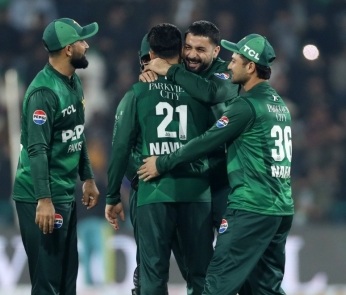
Hosts show spin strength as tourists look for response in Lahore
Asher Butt
Pakistan’s opening victory in the three-match T20I series against Australia was more than just a morale boost—it was a statement of intent ahead of the World Cup. Their 22-run triumph at the Gaddafi Stadium broke a seven-year drought against the Australians in this format, underscoring the value of disciplined bowling and timely batting contributions.
The match highlighted Pakistan’s growing reliance on spin as a decisive weapon. Abrar Ahmed’s 2 for 10 was the standout performance, but the collective effort of Shadab Khan, Mohammad Nawaz, and Saim Ayub ensured Australia never found rhythm in their chase. The dry Lahore surface offered grip and low bounce, conditions that Pakistan’s spinners exploited with precision. Australia, in contrast, struggled to adapt, losing wickets at regular intervals and failing to build partnerships beyond Cameron Green’s gritty 36.
With the bat, Pakistan’s innings was shaped by the second-wicket stand between Saim Ayub (40 off 22) and Salman Ali Agha (39 off 27). Their aggressive stroke play lifted the team after Sahibzada Farhan’s first-ball dismissal and gave Pakistan a platform to push towards 170. Yet, the late collapse in the 19th over exposed a familiar weakness—the inability to sustain momentum in the death overs. Babar Azam’s 24 and Mohammad Nawaz’s unbeaten 15 were useful contributions, but Pakistan will need greater consistency from their middle order if they are to challenge stronger opponents in the World Cup.
Australia’s bowling attack, led by Adam Zampa’s 4 for 24, kept them in the contest. Zampa’s control and variations dismantled Pakistan’s middle order, while debutants Mahli Beardman (2 for 33) and Xavier Bartlett (2 for 26) showed promise. However, their batting faltered under pressure. Travis Head’s quick 23 gave them a flying start, but the lack of sustained partnerships left them chasing shadows. Bartlett’s late unbeaten 33 only reduced the margin of defeat.
Looking ahead to the second T20I on Saturday, Pakistan will aim to seal the series and carry momentum into the World Cup. Their strategy will again revolve around spin, with Abrar, Shadab, and Nawaz expected to exploit the sluggish surface. Shaheen Afridi and Ayub with the new ball will be crucial in unsettling Australia’s top order early. Batting-wise, Farhan will be eager to redeem himself, while Babar and Fakhar Zaman must provide stability to avoid another mid-innings slump.
Australia, meanwhile, are likely to field a stronger XI with senior players such as Mitchell Marsh and Marcus Stoinis returning. Their inclusion will add depth to both batting and bowling, giving the side more balance. Head remains their key aggressor in the powerplay, while Green’s ability to anchor and accelerate will be vital. Zampa’s role as the lead spinner will be central again, especially if conditions mirror the first game.
The pitch at the Gaddafi Stadium is expected to remain slow, with spinners dictating terms. Statistics show that teams batting first have a 62% win rate here, making the toss a significant factor. Pakistan’s familiarity with these conditions gives them the edge, but Australia’s experienced campaigners could tilt the balance if they adapt quickly.
The second T20I promises another intriguing contest: Pakistan’s spin-dominated strategy against Australia’s bid to recalibrate with a stronger lineup. With the World Cup looming, both sides will treat this clash as more than just a series decider—it is a test of readiness for the challenges ahead