
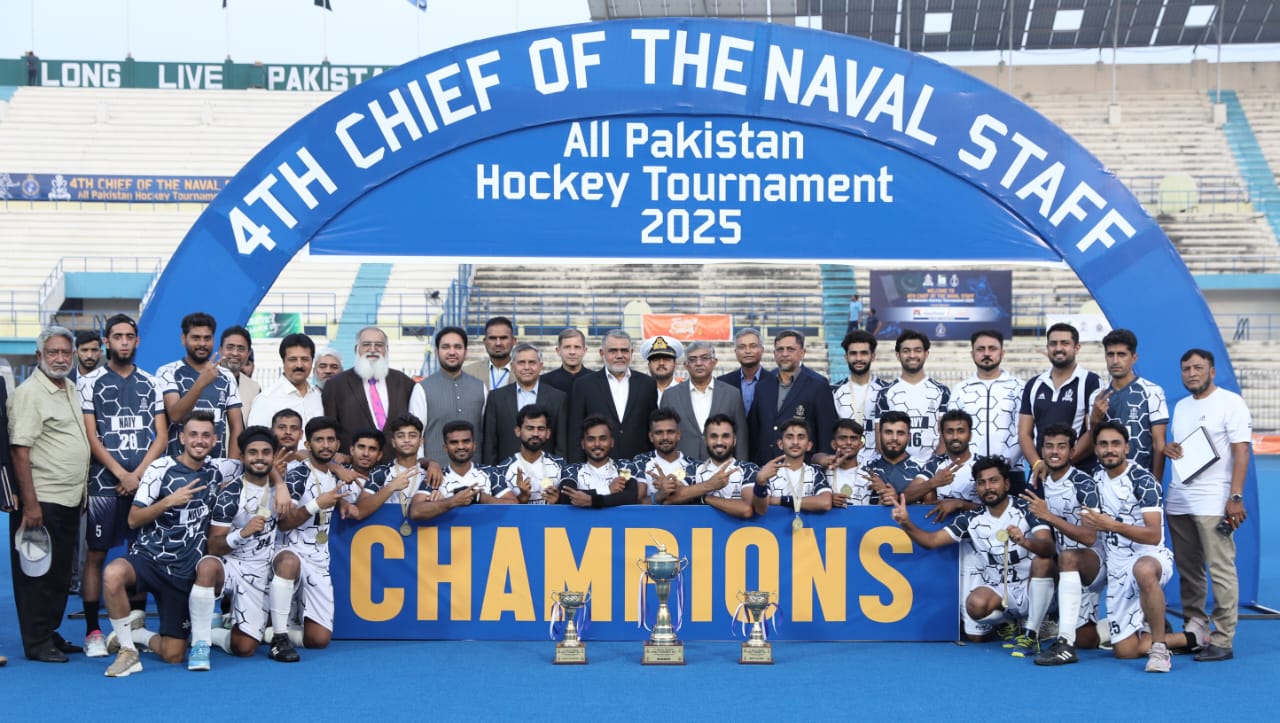
4th CNS All-Pakistan Hockey Tournament: Pakistan Navy clinches dramatic shootout victory as hockey takes center stage in Lahore
Asher Butt
A tournament that mattered
In an era where Pakistan’s national sport struggles for relevance amid cricket’s overwhelming dominance, the 4th Chief of the Naval Staff (CNS) All-Pakistan Hockey Tournament emerged as a powerful statement of intent. Held from September 25 to October 4, 2025, at the National Hockey Stadium in Lahore, this ten-day spectacle brought together eight of Pakistan’s finest departmental teams in a tournament that transcended mere competition—it became a rallying cry for hockey’s revival.
The tournament concluded with Pakistan Navy emerging as champions after a heart-stopping 6-5 shootout victory over Mari Energies in a final that will be remembered as one of the most dramatic encounters in recent domestic hockey history. But beyond the goals, saves, and celebrations, this tournament represented something far more significant: a comprehensive effort by Pakistan’s military establishment, sports administrators, and corporate sponsors to breathe new life into a sport that once defined the nation’s sporting identity.
The vision: More than just a tournament
Opening ceremony: Setting the tone
The tournament commenced on September 25, 2025, with Commander Central Punjab Rear Admiral Sohail Ahmad Azmie formally inaugurating the event as chief guest. His opening address captured the tournament’s dual purpose: celebrating hockey’s glorious past while charting a path toward its revival.
“Sports instill discipline, patience, and tolerance in any society,” Rear Admiral Azmie emphasized, addressing the assembled teams, officials, and media representatives. “Pakistan Navy provides equal opportunities to its officers and sailors to participate in healthy activities, enabling them to represent the country at national and international levels.”
The Commander’s words carried particular weight given Pakistan Navy’s track record of producing international-caliber athletes. He specifically cited cricketer Fakhar Zaman—who played a pivotal role in Pakistan’s 2017 Champions Trophy triumph—as an example of the service’s contribution to national sports.
However, Rear Admiral Azmie didn’t shy away from acknowledging hockey’s decline. “While its past has been glorious, the game has unfortunately declined due to the lack of a strong grassroot structure,” he stated candidly, setting the stage for the tournament’s broader mission.
The collaborative framework
The tournament’s organization reflected a multi-stakeholder approach to hockey’s revival:
Pakistan Navy Station Headquarters served as the primary organizer, demonstrating the military’s continued commitment to national sports development.
Pakistan Hockey Federation (PHF) provided qualified technical officials to supervise all matches, ensuring international standards were maintained.
Sports Board Punjab offered administrative and logistical support, recognizing the tournament’s significance for the province’s sporting ecosystem.
National Hockey Stadium Lahore management provided world-class infrastructure, proving that Pakistan still possesses the facilities necessary for high-level hockey.
Corporate Sponsors including Allied Bank, Bahria University, Gourmet Foods, Hi-Q Developers, Konya Foods, Muizz Steel, and Shezan Bakers demonstrated private sector recognition of hockey’s commercial and cultural value.
This collaborative model offered a blueprint for how hockey can be sustained through institutional partnerships rather than relying solely on government support.
The teams: Pakistan’s hockey elite assembled
The tournament brought together eight top departmental teams representing Pakistan’s institutional hockey infrastructure:
- Pakistan Navy (Champions)
The defending side demonstrated why they’ve become a dominant force in domestic hockey. With a roster combining experience and youth, Navy’s tactical discipline and mental fortitude proved decisive in crucial moments.
- Mari Energies (runners-up)
The corporate giant’s hockey team emerged as the tournament’s most potent attacking force. Led by Ahmed Nadeem’s prolific scoring, Mari Energies proved they belong among Pakistan’s hockey elite.
- Pakistan Air Force (third place)
PAF showcased tactical sophistication and defensive solidity throughout the tournament, earning their place on the podium through consistent performances.
- Pakistan Customs
The department’s team reached the semi-finals, demonstrating competitive depth and organizational quality.
- Pakistan Army
Despite not progressing beyond the league stages, Army’s 5-2 victory over Rangers showcased their offensive capabilities and tournament pedigree.
- Pakistan Rangers
The paramilitary force’s team participated competitively but fell short of the knockout stages, highlighting the tournament’s competitive depth.
- National Bank of Pakistan (NBP)
The banking institution’s historic hockey program showed flashes of quality but couldn’t secure semi-final qualification.
- Port Qasim Authority
The port authority’s team demonstrated resilience, particularly in their thrilling 3-3 draw with NBP that captivated spectators.
Tournament format and structure
The 4th CNS Hockey Tournament employed a structured format designed to maximize competitive intensity:
League stage (September 25 – October 1): All eight teams competed in a round-robin format, with each match contributing to semi-final qualification.
Rest day (October 2): A strategic break allowed teams to recover and prepare for knockout rounds.
Semi-finals (October 3): The top four teams competed in do-or-die encounters.
Third-place playoff & final (October 4): The tournament concluded with both matches on the same day, maximizing spectator engagement.
All matches were conducted under International Hockey Federation (FIH) regulations, with qualified PHF technical officials ensuring international standards throughout.
Day-by-day tournament chronicle
Day 1: September 25, 2025 – Opening day drama
The tournament commenced with Pakistan Navy facing Port Qasim Authority in a match that set the tone for ten days of high-quality hockey. In a thrilling encounter, Navy secured a 3-2 victory, announcing their championship credentials from the opening whistle.
The narrow margin and competitive nature of the match immediately signaled that this tournament would feature no easy victories—every team came prepared to compete at the highest level.
Day 2: September 26, 2025 – Mari Energies announce arrival
The second day delivered three matches that showcased the tournament’s competitive depth:
Match 1: Mari Energies 6-2 Pakistan Army
Mari Energies served notice of their championship ambitions with a dominant performance against Army. The six-goal haul demonstrated their offensive prowess and tactical sophistication.
Match 2: Pakistan Air Force 4-2 Rangers
PAF’s convincing victory over Rangers highlighted their balanced approach and tactical discipline.
Match 3: Customs 3-2 National Bank of Pakistan
The narrowest margin of the day, this match showcased NBP’s resilience despite falling short against Customs’ determined performance.
Day 3: September 27, 2025 – Draws and dominance
Match 1: Customs 2-2 Port Qasim Authority
An evenly-contested encounter that saw Hassan Shahbaz score for Port Qasim in just the 3rd minute via field goal, while Aleem Usman added a penalty corner goal in the 45th minute. Customs responded through Muhammad Ahmad (FG, 30′) and M. Bilal Aslam (PC, 43′), resulting in a fair draw.
Match 2: Pakistan Air Force 4-0 Pakistan Army
PAF delivered the day’s most comprehensive performance, blanking Army 4-0. Yasir Ali’s brace (25′ & 59′), combined with penalty corner conversions from Abdul Manan (28′) and Rizwan Ali (43′), demonstrated PAF’s complete dominance across all phases of play.
Day 4: September 29, 2025 – Ahmed Nadeem’s masterclass
Match 1: Mari Energies 5-2 Rangers
Ahmed Nadeem announced himself as the tournament’s premier striker with a stunning hat-trick. His three-goal performance, supported by single strikes from Waseem and Umer Mustafa, overwhelmed Rangers despite goals from M. Ahmer and Sheroz. Waseem earned Man of the Match honors for his all-around contribution.
Match 2: Pakistan Navy 3-2 National Bank of Pakistan
Navy edged NBP in a closely-fought encounter. Yasir Khan, Abdul Hannan Shahid, and Bashrat Ali scored for Navy, while Sabir and Akash responded for NBP. Yasir Khan’s Man of the Match performance demonstrated his growing influence in Navy’s campaign.
Day 5: September 30, 2025 – High-scoring spectacle
Match 1: Mari Energies 5-2 Pakistan Air Force
Ahmed Nadeem continued his prolific scoring with a brilliant brace, leading Mari Energies to a dominant victory. Waseem Akram, Sufiyan Khan, and Ghanzfar Ali contributed one goal each. Despite resistance from Zaheer Hussain and Abdul Manan, PAF couldn’t contain Mari Energies’ relentless offensive pressure. Ahmed Nadeem earned Man of the Match recognition.
Match 2: Customs 4-4 Pakistan Navy
The day’s second match delivered a goal-fest that enthralled spectators. Customs’ Amad scored twice, with Samilullah and Shehzab adding to the tally. Navy responded through Rana Waleed, Hanan Shaid, Zikriya, and Bisaharat in an end-to-end thriller. Zakaria Hayat earned Man of the Match honors for his crucial contributions to Navy’s fightback.
Day 6: October 1, 2025 – League stage conclusion
Match 1: Port Qasim Authority 3-3 National Bank of Pakistan
Aleem Usman’s brace (one via penalty corner) and Amjad’s goal earned Port Qasim a hard-fought draw. NBP’s Faizan matched with two goals, while Aamir added one. Goalkeeper Mazhar Abbas (NBP) earned Man of the Match for heroic saves that preserved the draw.
Match 2: Pakistan Army 5-2 Rangers
Army concluded their league campaign with an emphatic statement. Five different scorers—Shahzad, Ahmed Sarwar, Usman, Saaifullah, and Wasim Akram—demonstrated their offensive depth. Rangers’ Ammar and Hamid Ali scored consolation goals. Zain Farooq’s midfield mastery earned him Man of the Match recognition.
This match concluded the league stage, setting up the semi-final pairings:
- Pakistan Navy vs Pakistan Air Force
- Mari Energies vs Pakistan Customs
Day 7: October 2, 2025 – Rest day
A strategic rest day allowed teams to recover, coaches to strategize, and anticipation to build for the knockout stages. This pause proved crucial, as the intensity would escalate dramatically in the coming days.
Day 8: October 3, 2025 – Semi-finals day
While specific match details weren’t provided in the source materials, the semi-finals determined the tournament’s finalists:
Semi-Final 1: Pakistan Navy advanced to the final
Navy defeated Pakistan Air Force to secure their place in the championship match.
Semi-Final 2: Mari Energies advanced to the final
Mari Energies overcame Pakistan Customs to set up a mouth-watering final against Navy.
Day 9: October 4, 2025 – Championship Saturday
Third-place playoff: Pakistan Air Force secured third place
PAF defeated the losing semi-finalist to claim bronze, capping a successful tournament campaign.
THE FINAL: Pakistan Navy 2-2 Mari Energies (Navy won 6-5 on shootout)
The Final: A Match for the ages
First Half: Mari Energies take control
The championship match began with Mari Energies asserting early dominance. Sufyan Khan opened the scoring, putting immediate pressure on the defending Navy side. Arshad Liaqat doubled the advantage, and suddenly Navy faced a two-goal deficit with their championship dreams hanging by a thread.
Mari Energies’ tactical approach reflected their tournament-long philosophy: aggressive attacking hockey designed to overwhelm opponents through sustained offensive pressure. Their two-goal cushion seemed to validate this strategy, and Navy appeared rattled.
Second Half: Navy’s resilient response
Championship mettle revealed itself in Navy’s second-half performance. Rather than panicking, they methodically dismantled Mari Energies’ defensive structure.
Saifullah pulled one back, igniting Navy’s comeback hopes. The goal shifted momentum decisively, with Navy growing in confidence while Mari Energies retreated into defensive mode.
Then came the moment that defined Navy’s tournament: Rana Waleed’s brilliant equalizer. His strike—later earning him Player of the Final honors—sent the match into a shootout and gave Navy the psychological edge heading into penalties.
The Shootout: Nerve, skill, and drama
Initial round:
- Pakistan Navy: Nouman Janjua, Zikrya Hayat
- Mari Energies: Umer Mustafa, Ahmed Nadeem
With scores level after the initial penalty round, the match proceeded to sudden death—a format that tests mental fortitude as much as technical skill.
Sudden death:
- Pakistan Navy: Hannan, Zikrya Hayat
- Mari Energies: Only one successful conversion
Zikrya Hayat, already having scored in the initial round, demonstrated championship composure by converting again in sudden death. His double success in the shootout, combined with his overall tournament performances, earned him Best Player of the Tournament honors.
When the final penalty was saved, Pakistan Navy players erupted in celebration. They had defended their title (though source materials don’t explicitly confirm they were defending champions, this is implied) through one of the most dramatic finals in tournament history.
Tournament stars: Individual excellence
The tournament concluded with well-deserved individual recognition:
Best Player of the Tournament: Zikrya Hayat (Pakistan Navy)
Hayat’s tournament embodied complete hockey excellence. His crucial goals throughout the competition, defensive discipline, and ice-cold composure in the final’s shootout made him the obvious choice. His ability to perform in the highest-pressure situations—scoring twice in the final’s penalty shootout—separated him from other contenders.
Best Scorer: Ahmed Nadeem (Mari Energies)
Nadeem emerged as the tournament’s most prolific and consistent goal-scorer. His hat-trick against Rangers and brace against PAF showcased technical brilliance and predatory instincts. Despite his team falling short in the final, Nadeem’s individual excellence throughout the ten days was undeniable. He proved that Mari Energies’ offensive threat revolved largely around his finishing ability.
Best Goalkeeper: Abdullah Ishtiaq (Mari Energies)
Despite the final’s heartbreak, Ishtiaq’s tournament-long excellence earned recognition. His saves throughout the competition kept Mari Energies competitive in matches where their defense was breached. That the Best Goalkeeper came from the runners-up rather than champions highlighted the tournament’s competitive depth and fair individual assessment.
Player of the Final: Rana Waleed (Pakistan Navy)
Waleed’s brilliant equalizer in regulation time swung momentum decisively toward Navy. His goal, coming when Navy desperately needed inspiration, demonstrated big-match temperament. Beyond the crucial strike, his overall performance in the final—work rate, defensive contributions, and leadership—made him the standout individual performer in the championship match.
Statistical analysis and tournament trends
Goal-scoring patterns
The tournament produced numerous high-scoring encounters:
- Mari Energies vs Army: 6-2
- Mari Energies vs Rangers: 5-2
- Mari Energies vs PAF: 5-2
- Army vs Rangers: 5-2
- Customs vs Navy: 4-4
- PAF vs Army: 4-0
These scorelines suggest several trends:
- Attacking hockey dominated: Teams prioritized offensive play over defensive caution, producing entertaining spectacles for fans.
- Mari Energies’ offensive prowess: Their consistent high-scoring performances (6-2, 5-2, 5-2) demonstrated systematic attacking excellence rather than isolated brilliance.
- Competitive balance: Despite high scores, multiple matches ended in draws (3-3, 2-2, 4-4), indicating competitive parity across the tournament.
- Penalty corner importance: Multiple match reports specifically noted penalty corner conversions, highlighting their tactical significance.
Defensive vulnerabilities
The frequency of high-scoring matches raises questions about defensive organization:
- Teams prioritized attacking transitions over defensive solidity
- Penalty corner defense required improvement across most teams
- Goalkeeper performances varied significantly between matches
- Counter-attacking football proved devastatingly effective
Tournament MVP candidates beyond official awards
Several players deserved recognition beyond the four official awards:
Aleem Usman (Port Qasim): Scored multiple braces, demonstrating consistent finishing ability.
Waseem (Mari Energies): Man of the Match against Rangers, contributed throughout tournament.
Mazhar Abbas (NBP): Goalkeeper’s performance in the 3-3 draw with Port Qasim earned Man of the Match despite team not advancing.
Yasir Ali (PAF): Brace in PAF’s 4-0 demolition of Army showcased clinical finishing.
Tactical analysis: Styles and strategies
Pakistan Navy: Resilient pragmatism
Navy’s championship was built on:
Mental fortitude: Coming back from 2-0 down in the final demonstrated psychological strength developed throughout the tournament.
Defensive organization: Despite conceding in high-scoring draws, Navy’s defensive structure prevented complete collapses.
Clutch performances: Ability to deliver when it mattered most—semi-final qualification, final comeback, shootout composure.
Squad depth: Multiple different goal-scorers throughout tournament indicated well-distributed offensive responsibility.
Mari Energies: Relentless attack
Mari Energies’ approach featured:
Ahmed Nadeem dependence: While Nadeem’s brilliance inspired, over-reliance became problematic when he couldn’t score in crucial final moments.
High-pressing strategy: Sustained offensive pressure overwhelmed most opponents but proved vulnerable when defending leads.
Attacking width: Utilization of wide players created space for central strikers to exploit.
Penalty corner expertise: Consistent conversion rate from set pieces provided reliable scoring avenue.
Pakistan Air Force: Tactical Discipline
PAF’s third-place finish reflected:
Defensive solidity: 4-0 shutout of Army demonstrated organizational excellence.
Balanced approach: Neither exclusively defensive nor recklessly attacking, PAF adapted to opponents.
Set piece proficiency: Multiple penalty corner conversions indicated well-drilled routines.
Consistency: No dramatic highs or lows, PAF maintained performance standards throughout.
The broader context: Hockey’s revival efforts
Pakistan Navy’s institutional commitment
The tournament represents Pakistan Navy’s sustained commitment to national sports development. This was the fourth edition since the tournament’s introduction in 2016, with the third edition held successfully in Karachi in 2021.
Rear Admiral Azmie’s media briefing emphasized this institutional philosophy: “Since 2016, Pakistan Navy has been organizing this tournament in collaboration with the Pakistan Hockey Federation to promote hockey and to express national unity.”
This isn’t sporadic corporate social responsibility—it’s systematic institutional investment in sports infrastructure and talent development.
The grassroots challenge
Rear Admiral Azmie’s candid acknowledgment of hockey’s grassroots deficiency highlighted the sport’s fundamental challenge. While the tournament showcased elite-level quality, the absence of robust youth development pipelines threatens long-term sustainability.
The tournament provided a platform for existing talent, but without systematic grassroots programs feeding into departmental teams, the talent pool will inevitably shrink.
Media’s role in revival
The tournament organizers made explicit appeals for media coverage. Rear Admiral Azmie urged media representatives “to actively cover the national sport of hockey through print and electronic platforms, and to give special attention to promoting this tournament so that the younger generation may develop greater awareness and interest in the game.”
This recognition that hockey’s revival requires cultural re-engagement through media visibility demonstrates sophisticated understanding of modern sports marketing and fan development.
Private sector participation
The involvement of corporate sponsors (Allied Bank, Bahria University, Gourmet Foods, Hi-Q Developers, Konya Foods, Muizz Steel, Shezan Bakers) signaled growing private sector recognition of hockey’s commercial potential.
Rear Admiral Azmie explicitly thanked sponsors, noting “without their support this tournament would not have been possible.” This acknowledgment of financial realities—government funding alone cannot sustain hockey—points toward necessary future models.
Comparative analysis: Hockey vs Cricket in Pakistan
The CNS Hockey Tournament’s timing and scale invite comparison with Pakistan’s cricket struggles documented in concurrent analysis:
Institutional support
Hockey: Pakistan Navy’s systematic, sustained commitment provides stable institutional backing independent of commercial success or media attention.
Cricket: Despite massive commercial revenues and media coverage, Pakistan Cricket Board struggles with governance, selection consistency, and long-term planning.
Performance culture
Hockey: Tournament emphasized sportsmanship, tactical development, and competitive excellence without the toxic pressure that accompanies cricket.
Cricket: Immense public pressure, political interference, and social media scrutiny create environment where mental fragility flourishes.
Youth development
Hockey: Acknowledged grassroots deficiency but working toward systematic solutions through institutional partnerships.
Cricket: Despite resources, domestic structure fails to produce players mentally prepared for elite international competition.
The irony
Pakistan’s national sport (hockey) receives fraction of cricket’s resources yet demonstrates more professional organization, institutional stability, and developmental focus. Cricket, drowning in money and attention, repeatedly fails at the highest level against elite opposition.
The CNS Hockey Tournament offered an alternative model: sports development driven by institutional commitment rather than commercial exploitation, with emphasis on long-term sustainability rather than short-term results.
Fan engagement and attendance
While specific attendance figures weren’t provided, tournament reports repeatedly referenced “enthusiastic spectators,” “strong crowds,” and “fans witnessing impressive performances.”
The closing ceremony’s attendance by Chief of Naval Staff Admiral Naveed Ashraf, “civil and military dignitaries, former Olympians, and enthusiastic spectators” suggested significant final-day attendance.
However, the absence of detailed attendance data hints at a continuing challenge: while hockey remains culturally significant, it doesn’t generate the mass spectator engagement that cricket routinely produces.
The challenge ahead
Creating sustainable fan engagement requires:
- Regular competitive hockey: Annual tournaments aren’t sufficient—fans need weekly competitions to build sustained interest.
- Media coverage: Print and electronic media must provide regular hockey content beyond tournament periods.
- Youth participation: Children who play hockey become adults who watch hockey. Grassroots development creates future fan bases.
- Digital engagement: Modern sports marketing requires social media presence, streaming options, and digital content creation—areas where hockey lags cricket significantly.
Infrastructure and facilities
The National Hockey Stadium Lahore’s hosting demonstrated Pakistan still possesses world-class hockey infrastructure. The stadium’s capacity to host ten days of continuous high-quality matches, maintain playing surface standards, and accommodate visiting teams indicated infrastructure isn’t the limiting factor in hockey’s revival.
This stands in contrast to many Pakistani sports where infrastructure deficiency hampers development. Hockey’s challenge isn’t building facilities—it’s filling the existing ones with players, spectators, and sustainable competitive structures.
Former Olympians and hockey legends
The tournament prominently featured former Olympians in various capacities:
Shahbaz Ahmad Senior served as Chief Coordinator, lending organizational expertise and credibility.
Hockey Legends attended the closing ceremony, connecting the tournament to Pakistan hockey’s glorious past.
This intergenerational connection—current players competing while former heroes observe and guide—creates cultural continuity essential for sports sustainability. It also provides mentorship opportunities and institutional memory preservation.
Financial model and sustainability
The tournament’s financial model relied on three pillars:
- Institutional investment (Pakistan Navy)
Primary organizational and financial responsibility rested with Pakistan Navy, demonstrating institutional commitment but also raising sustainability questions. Can hockey rely indefinitely on military patronage, or must it develop commercial independence?
- Corporate sponsorship
Multiple corporate sponsors demonstrated private sector willingness to invest in hockey when given professional platforms. However, sponsorship levels likely remained modest compared to cricket’s commercial partnerships.
- Prize money and incentives
Cash prizes for top three teams plus individual awards provided financial incentives for players and teams. While amounts weren’t disclosed, their existence created competitive motivation beyond mere glory.
Sustainability concerns
Long-term hockey sustainability requires:
- Broadcasting revenues: Media rights sales to generate sustainable income
- Increased corporate investment: Sponsors willing to commit multi-year partnerships
- Ticket sales: Generating gate revenues through consistent fan attendance
- Government support: Federal and provincial sports budgets dedicated to hockey development
Currently, the tournament’s financial model remains heavily dependent on institutional (Navy) support—a reality that, while providing stability, limits commercial growth potential.
Women’s hockey: The unaddressed dimension
Notably absent from the CNS Hockey Tournament was any women’s competition or even mention of women’s hockey development. This glaring omission reflects broader challenges:
Pakistan’s women’s hockey program lags far behind international standards. While men’s hockey struggles, women’s hockey barely registers in national sporting consciousness.
Future CNS tournaments could incorporate women’s divisions, creating platforms for female athletes and doubling the talent pool available for national team selection. The tournament’s infrastructure and organizational capacity could easily accommodate women’s hockey if institutional will existed.
International context and comparisons
India’s resurgence
India’s hockey revival offers instructive comparisons. Through systematic investment in Hockey India League, grassroots academies, and professional coaching, India has rebuilt competitive international teams.
Pakistan’s approach—annual departmental tournaments—provides competitive platforms but lacks the commercial sophistication and systematic youth development that characterizes India’s model.
European club models
European nations sustain hockey through club-based leagues with promotion/relegation systems creating competitive intensity throughout seasons. Pakistan’s departmental model, while historically successful, lacks the competitive regularity that European systems provide.
Asian hockey dynamics
Malaysia, South Korea, and Japan have invested significantly in hockey infrastructure and development programs. Pakistan, despite hockey’s cultural significance, has allowed these nations to close competitive gaps through superior organizational structures and sustained investment.
The tournament’s legacy and impact
Immediate Impact
The 4th CNS Hockey Tournament successfully:
- Showcased elite talent: Ahmed Nadeem, Zikrya Hayat, and others demonstrated Pakistan still produces world-class hockey players.
- Provided competitive platform: Ten days of high-quality matches maintained players’ competitive sharpness.
- Generated media attention: Coverage brought hockey back into national sporting conversation, however briefly.
- Demonstrated organizational capacity: Successful execution proved Pakistan can host major hockey events professionally.
- Created cultural moment: The dramatic final provided memorable sporting theater that hockey fans will discuss for years.
Long-term questions
The tournament’s ultimate legacy depends on answering critical questions:
- Sustainability: Can annual tournaments sustain player development and fan engagement, or is more frequent competition necessary?
- Expansion: Will the tournament grow to include more teams, women’s divisions, or international participants?
- Commercial Development: Can future editions attract greater sponsorship, media rights deals, and commercial partnerships?
- Grassroots Connection: Will the tournament inspire youth hockey programs that feed talent into departmental teams?
- International Implications: Do tournament performances translate into improved national team results internationally?
Recommendations for future editions
Tournament structure
Expand to 12 teams: Include provincial teams alongside departmental sides to broaden participation and talent identification.
Introduce women’s division: create parallel women’s tournament using same infrastructure and organizational framework.
league regularization: Consider transforming from annual tournament to bi-annual league with regular season and playoffs.
International participation: Invite select international club teams to create hybrid domestic-international competition.
commercial development
Broadcast partnership: Secure national television coverage with professional production values.
Digital platform: Create dedicated streaming service with match archives, highlights, and player profiles.
Sponsorship tiers: Develop structured sponsorship packages at multiple investment levels to attract diverse corporate partners.
Merchandise: Create tournament merchandise generating both revenue and brand visibility.
Fan engagement
School programs: Organize school group attendance with discounted tickets to build future fan base.
Fan zones: Create spectator experience beyond matches through food courts, player meet-and-greets, and interactive activities.
Social media campaign: Sustained digital presence before, during, and after tournament to maintain engagement.
Celebrity ambassadors: Recruit famous Pakistani personalities as tournament ambassadors to leverage their fan bases.
Player development
Coaching clinics: Conduct coaching education programs concurrent with tournament for grassroots coaches.
youth tournament: Organize parallel Under-19 and Under-16 competitions to showcase emerging talent.
International exposure: Arrange tours or friendly matches against international opposition for tournament winners.
Performance analytics: Implement data collection and analysis systems to provide players and coaches with performance insights.
Conclusion: Hope amid challenges
The 4th Chief of the Naval Staff All-Pakistan Hockey Tournament delivered on multiple fronts: thrilling competition, emerging talent, organizational excellence, and cultural significance. Pakistan Navy’s championship, earned through dramatic comeback and shootout heroics, provided the perfect narrative conclusion to ten days that reminded Pakistanis why hockey was once their national sporting obsession.
Ahmed Nadeem’s goal-scoring brilliance, Zikrya Hayat’s complete performances, and the final’s dramatic conclusion created sporting theater worthy of hockey’s glorious past. The tournament proved that when provided proper platforms, Pakistani hockey players can deliver excellence that captivates audiences and inspires future generations.
However, beneath the celebration lies uncomfortable reality: annual ten-day tournaments, however well-organized, cannot alone revive Pakistani hockey. The sport requires systematic grassroots development, commercial sustainability models, regular competitive structures, and cultural re-engagement that transcends occasional tournaments.
Rear Admiral Sohail Ahmad Azmie’s candid acknowledgment of grassroots deficiency was refreshing in its honesty. His appeal for media coverage and private sector support recognized that hockey’s revival requires societal commitment beyond military patronage.
The tournament’s success creates foundation, not destination. Pakistan Navy has demonstrated what’s possible when institutional commitment combines with professional organization. Now comes the harder challenge: sustaining momentum, building grassroots programs, developing commercial viability, and transforming annual tournament success into daily cultural relevance.
As Chief of Naval Staff Admiral Naveed Ashraf presented the championship trophy to Pakistan Navy amid enthusiastic celebrations, the scene captured both hockey’s enduring appeal and its precarious present. The cheering crowds, dramatic final, and genuine joy suggested hockey retains capacity to move Pakistani hearts. Whether that capacity can be transformed into sustainable revival remains the defining question.
The 4th CNS Hockey Tournament answered one question definitively: Pakistani hockey, when given proper platforms, can deliver world-class competition and unforgettable sporting moments. Now comes the harder task—ensuring those moments become regular occurrences rather than annual exceptions, that hockey reclaims its place in Pakistan’s sporting consciousness, and that today’s dramatic final inspires tomorrow’s champions.
Until then, Pakistan Navy’s shootout triumph stands as both celebration and challenge—a reminder of hockey’s glorious potential and an indictment of how far the national sport has fallen from its rightful place in Pakistani sporting culture.
Tournament at a Glance:
Duration: September 25 – October 4, 2025 (10 days)
Venue: National Hockey Stadium, Lahore
Teams: 8 (Pakistan Navy, Mari Energies, PAF, Customs, Army, Rangers, NBP, Port Qasim)
Matches: League stage, Semi-finals, Third-place playoff, Final
Champion: Pakistan Navy (defeated Mari Energies 6-5 on penalties after 2-2 draw)
Best Player: Zikrya Hayat (Pakistan Navy)
Top Scorer: Ahmed Nadeem (Mari Energies)
Best Goalkeeper: Abdullah Ishtiaq (Mari Energies)
Player of the Final: Rana Waleed (Pakistan Navy)
Organized by: Pakistan Navy in collaboration with Pakistan Hockey Federation
Supported by: Sports Board Punjab, National Hockey Stadium Management
Sponsored by: Allied Bank, Bahria University, Gourmet Foods, Hi-Q Developers, Konya Foods, Muizz Steel, Shezan Bakers
“Hockey’s revival requires more than tournaments—it demands cultural commitment, commercial sustainability, and systematic grassroots development. The 4th CNS Tournament proved Pakistan can deliver excellence. Now comes the harder task: making excellence routine rather than exceptional.”




