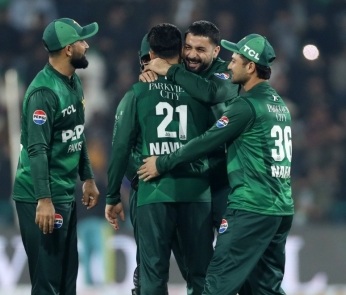
A crisis of confidence: Pakistan’s series loss to Bangladesh
Asher Butt
The recent ODI series defeat against Bangladesh—a 2-1 loss that should never have been this close—has exposed the deep structural rot within Pakistani cricket. What makes this defeat particularly galling is not just the final scoreline, but the manner in which it unfolded. A humiliating eight-wicket loss in the first ODI, followed by a consolation victory, and then an 11-run defeat in the series decider tells a story of inconsistency, poor planning, and institutional failure not only at the inter-national but deeply at the domestic level.
To understand the gravity of this situation, one spoke with former first-class cricketer Afzaal Butt (who was part of the domestic team that once played Bangladesh in mid 90s), whose observations cut through the diplomatic niceties that often surround cricket discussions in Pakistan.
“I didn’t even know pakistan had a match today”
Afzaal Butt’s opening remark is perhaps the most damning indictment of where Pakistan cricket currently stands. “I didn’t even know that Pakistan had a match against Bangladesh today,” he admitted. “When I checked the score before heading to work, I saw that Pakistan had lost.”
This lack of awareness about the national team’s fixtures reflects a broader disconnection between Pakistan cricket and its audience. When former players—people who dedicated their lives to the sport—are unaware of matches, something has fundamentally broken in how cricket is marketed, scheduled, and valued in the country.
But Afzaal’s critique runs much deeper. He draws a sharp contrast between past and present, recalling the 1990s Wills Cup when a domestic Pakistani side (Allied Bank) chased 180 runs in just 15 overs against Bangladesh. “The point of telling you this is that 25 years ago, that country’s team couldn’t even beat a domestic Pakistani side,” he said. “Today, the Pakistan national team is losing matches to them.”
This historical perspective is crucial. Bangladesh cricket has undoubtedly improved, but Pakistan’s regression has been equally dramatic. From dominating associates to losing series against them—this trajectory speaks volumes about administrative failures.
The first ODI: A NIGHTMARE in Dhaka
The first ODI was not just a defeat; it was an embarrassment of historic proportions. Pakistan were bowled out for 114 in 30.4 overs after being put in to bat. Four debutants—Sahibzada Farhan, Maaz Sadaqat, Shamyl Hussain, and Abdul Samad—were handed caps, but the experimentation backfired spectacularly.
Bangladesh’s Nahid Rana ran through the Pakistani lineup with figures of 5 for 24, while Mehidy Hasan Miraz claimed 3 for 29. Only Faheem Ashraf’s late resistance (37 off 47 balls) pushed Pakistan past the 100-run mark after the side had slumped to 82 for 9.
In response, Bangladesh chased down the target in just 15.1 overs, losing only two wickets. Tanzid Hasan’s brutal 67 not out off 42 balls—featuring seven fours and five sixes—highlighted the gulf in class and intent between the two sides.
What made this defeat particularly alarming was the margin: eight wickets with 209 balls remaining. In ODI cricket, such dominance by a team traditionally considered weaker exposes fundamental flaws in preparation, skill, and mentality.
The second ODI: A mirage of hope
Just when despair had set in, Pakistan produced a commanding performance in the second ODI to level the series. Batting first, they posted 274 all out in 47.3 overs, powered by Maaz Sadaqat’s blistering 75 off 46 balls on debut—a half-century brought up in just 31 deliveries. Salman Ali Agha contributed 64, and Mohammad Rizwan added 44, helping Pakistan recover from a brief middle-order wobble.
Rain reduced Bangladesh’s chase to 243 in 32 overs under the DLS method, and Pakistan’s bowlers delivered a clinical performance. Shaheen Shah Afridi struck twice early, Mohammad Wasim removed Saif Hassan, and then Maaz Sadaqat—already the hero with the bat—claimed 3 for 23 with his left-arm spin. Haris Rauf grabbed three wickets as Bangladesh were bundled out for 114 in 23.3 overs.
The 128-run victory (on DLS) offered a glimpse of what this team could achieve. Maaz Sadaqat’s all-round performance was particularly encouraging, suggesting that Pakistan’s much-vaunted talent pool still exists. But as Afzaal Butt warns, talent alone is insufficient without proper nurturing.
“There is so much talent, but it is being destroyed,” he said. “If someone is incompetent, they should be removed.”
The third odi: Familiar failings
The series decider followed a painfully familiar pattern for Pakistani cricket fans. Bangladesh posted 290 for 5, with Tanzid Hasan scoring 107 and Towhid Hridoy remaining unbeaten on 48. Haris Rauf was the pick of Pakistan’s bowlers with 3 for 52, but the bowling unit as a whole lacked the penetration required to defend a chaseable total.
Pakistan’s response began catastrophically: three wickets lost inside the first three overs. Sahibzada Farhan, Maaz Sadaqat, and Mohammad Rizwan all departed cheaply, leaving Pakistan reeling at 17 for 3. What followed was a rearguard action of genuine quality—Salman Ali Agha’s magnificent 106 off 98 balls, supported by Saad Masood (38) and Shaheen Shah Afridi (37)—that brought Pakistan agonizingly close.
But close doesn’t count in international cricket. Pakistan fell 11 runs short, bowled out for 279 in the final over. Taskin Ahmed’s four-wicket haul and Mustafizur Rahman’s three wickets exposed the fragility of Pakistan’s batting lineup under pressure.
The root cause: Management and selection
Afzaal Butt’s analysis of Pakistan’s decline is unsparing and focuses on the fundamental issue: governance. “We sometimes compare ourselves to India or others, but we aren’t at that level anymore,” he said. “It’s right in front of you—we lost to America, we’ve lost to every team. The reason is our management and selection committee.”
His critique extends beyond mere incompetence to suggest systemic corruption: “No one wants to work for the sake of the country; everyone is just there to make money. The players are the same. I never criticize the players who get selected because it’s not their fault if they are brought in through favoritism (sifarishi). The fault lies with the selection committee whose job it is to evaluate them.”
This accusation of nepotism and favoritism in Pakistani cricket is not new, but it gains credibility when voiced by someone who has operated within the system. The constant chopping and changing—four debutants in the first ODI, an ever-revolving door of players—suggests a selection committee without a coherent vision.
“If a player is a product of favoritism, they won’t have the hunger to win for the country; they only look out for themselves,” Afzaal added.
His most pointed criticism, however, is reserved for the administrative structure: “You have seated a bureaucrat there, Khurram Niazi Sahab. What does he know about cricket? You should put a cricketer in that position who can build a team. Whenever I look, the board is filled with ‘market people’ just there to collect money.”
The numbers don’t lie
The statistics from this series paint a damning picture. In the first ODI, Pakistan’s total of 114 was their seventh-lowest in ODI history against Bangladesh. The margin of defeat—eight wickets with 209 balls remaining—was the most lopsided loss to Bangladesh in terms of balls remaining.
Across the three matches, Pakistan’s batting collapsed repeatedly: from 41 for 1 to 114 all out in the first ODI; from 103 for 1 to 274 all out in the second (a middle-order wobble masked by the eventual total); and from 17 for 3 to 279 all out in the third—always fighting from behind, never building sustained pressure.
Bowling-wise, Pakistan took 20 wickets across three matches but conceded 290-plus twice. Haris Rauf’s nine wickets at an average of 23.22 was a bright spot, but Shaheen Shah Afridi’s seven wickets at 31.14 reflects a bowler still searching for his best form.
A way forward?
The series defeat to Bangladesh should serve as a wake-up call, but Pakistani cricket has a history of ignoring such alarms. The talent exists—Maaz Sadaqat’s all-round performance, Salman Ali Agha’s century, glimpses from debutants—but talent without structure, without merit-based selection, without competent administration, is like a car without an engine.
Afzaal Butt’s concluding words should echo in the corridors of the PCB: “I don’t know where you are taking Pakistan’s cricket. There is so much talent, but it is being destroyed. If someone is incompetent, they should be removed.”
The question is whether those in power will listen, or whether Pakistan cricket will continue its slow decline from the heights of 1999—when domestic sides could chase 180 in 15 overs against Bangladesh—to the depths of 2026, where the national team loses series to the same opposition.
The answer to that question will determine not just the fate of this series, but the future of Pakistani cricket itself.