By Asher Butt
There was a time, not so long ago in the collective memory of Pakistan’s political landscape, when the neighborhood councilor held the keys to the community’s heart and progress. In a reflective meeting with the delegation of the Pakistan English Media Association (PEMA), former Punjab Chief Minister Hamza Shehbaz revisited this cherished ideal, suggesting that the heated, modern debate over carving out new provinces might never have arisen had we held fast to the principles of true local empowerment.
Led by PEMA President Rameez Khan, the discussion at the gathering felt less like a standard political briefing and more like a longing for a system that served the common man at his doorstep. Hamza painted a picture of a governance model rooted deeply in the soil of the community, arguing that had the local government system been allowed to flourish with constitutional sanctity—protected much like the tenures of the National and Provincial Assemblies—the demand for new provinces would have dissolved into the background. “We would have a proper setup in the system for every kind of development including sports infrastructure.” It was a vision of a Pakistan where development was not a gift from a distant capital, but a right cultivated in one’s own backyard.
The former CM admitted with a candid honesty that often gets lost in political rhetoric that the political class itself needed to engage in some soul-searching. He recalled how civil servants often whispered in the ears of sitting governments, warning that empowering local bodies would strip the provincial administration of its might. “Every blame cannot be placed on the establishment. Political parties should also do some soul-searching. Did we do our part?” Hamza asked, acknowledging with a touch of regret that even during his own party’s tenure, the empowerment of local governments fell short of the promise.
Hamza spoke nostalgically of an era when the bond between a politician and the voter was unbreakable, noting that the growing chasm between the two signals the downfall of political parties. “Creating distance from party workers and voters marked the downfall of political parties,” he remarked, emphasizing that politics thrives only when it remains a people’s movement.
Amidst the noise of the digital age, Hamza also found time to appreciate the quiet resilience of the English-language print media. He lauded institutions like the PEMA for maintaining high standards of journalism, noting that despite the explosion of electronic and social media, the English press remains a beacon of unbiased information. Its like sports that connects people and brings communities together and that togetherness should not let evaporate.
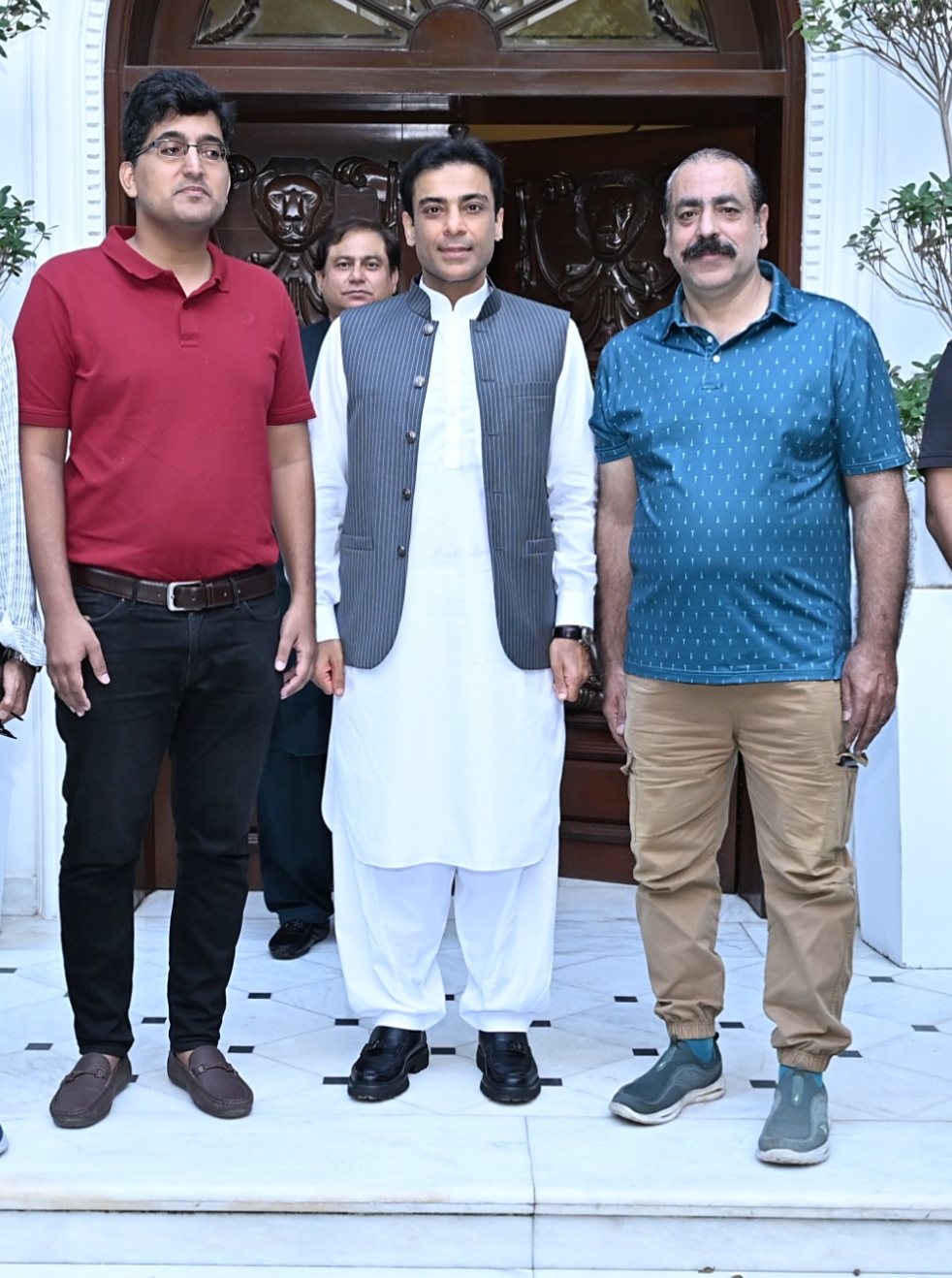
The meeting, attended by PEMA General Secretary Ali Raza, senior journalists Mubashir Bukhari, Baber Dogar, Mubashir Hasan, Semiullah Randhawa, and Hamza’s PSO Imran Goraya, served as a reminder that while the debate on provinces rages on, the real solution may lie in looking back at the roots we left behind.