In memoriam: Najam-us-Saeed
Veteran Test match scorer passes away on May 22 2026, leaving behind a legacy of precision, advocacy, and grassroots dedication
Asher Butt
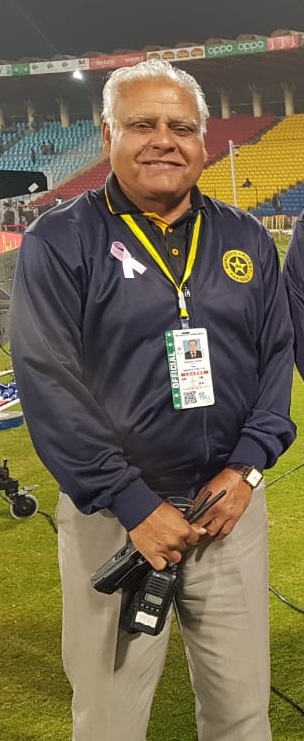
In the grand theater of cricket, the spotlight rarely falls on the scorer’s box. The heroes are those who wield the bat, bowl the ball, or take the catch. But every run, every wicket, every maiden over – every statistic that fans quote and historians rely upon – is made possible by the quiet, meticulous work of official scorers. On a sorrowful day in May 2026, Pakistan lost one of its finest practitioners of this invisible art. Najam-us-Saeed, a veteran Test match scorer whose career spanned several decades who was just a few more weeks away from his international career retirement with the upcoming Australia ODI series, passed away suddenly, leaving behind a void that will not easily be filled.
His departure marks the end of an era for cricket administration in Pakistan. While players captured the headlines and applause, Najam-us-Saeed worked tirelessly behind the scenes – his sharp eye, unwavering concentration, and profound understanding of cricket analytics making him one of the most respected figures in the scoring fraternity.
A career built on precision and dedication
Najam-us-Saeed’s professional journey was inseparable from the evolution of Pakistani cricket itself. Operating out of his home base in Lahore, he served as an official scorer for the Pakistan Cricket Board (PCB) and the Lahore Region Cricket Association (LRCA) across an active era spanning the late 20th century through to 2026.
His portfolio was staggering in its breadth and depth. He was trusted by the PCB to manage the complex, high-pressure demands of international Test match scoring – a role that requires not only mathematical accuracy but also an intuitive understanding of the game’s rhythms. Alongside his international duties, he logged thousands of hours of domestic First-Class cricket, ensuring that the statistical record of Pakistan’s premier competitions remained immaculate.
For decades, his presence at major international and domestic fixtures was a guarantee of administrative excellence. Colleagues recall that he could score an entire Test match without looking up from his book – not out of disinterest, but out of total obsession. Every ball, every run, every dismissal was captured with a precision that border on artistry.
More than numbers: An advocate for scorers’ rights
What distinguished Najam-us-Saeed from many in his profession was his willingness to speak up. He understood that scorers – the silent custodians of cricket’s memory – were often overlooked when it came to compensation, working conditions, and professional recognition.
Throughout his career, he actively championed the rights, fair compensation, and dignified working conditions of match scorers across Pakistan. He argued, often forcefully, that without accurate scoring, cricket matches would descend into chaos. His advocacy helped elevate the status of the profession, ensuring that younger scorers entering the field would not face the same struggles he had endured in his early years.
In this sense, Najam-us-Saeed was not just a scorer but a trade unionist for his craft – a man who believed that every contributor to the game deserved to be treated with respect. As he revealed during the PSL-11, umpires get dailies in dollars while a score is paid a few thousand rupees per match other than the humiliation they face in the name of security protocols at the hands of police when umpires are given VIP treatment.
Grassroots development: The Young Mozang Gymkhana connection
While his Test match assignments brought him national recognition, Najam-us-Saeed’s heart remained deeply rooted in local club cricket. He served as the Vice President of the Young Mozang Gymkhana club in Lahore, a role that allowed him to give back to the community that had nurtured his love for the game.
At the club level, he mentored young talent, sharing not just his knowledge of scoring but his broader understanding of cricket as a discipline of patience, observation, and integrity. He was a fixture at local matches, often arriving early and leaving late, ensuring that even the most obscure club fixture was properly recorded.
His investment in grassroots cricket reflected a simple philosophy: the health of the national game depends on the health of its foundations. By supporting local clubs and young players, Najam-us-Saeed was building the pipeline that would eventually produce Pakistan’s next generation of stars.
Official tributes: PCB and LRCA mourn
Following the announcement of his passing, tributes poured in from across the cricketing establishment.
Mohsin Naqvi, Chairman of the Pakistan Cricket Board, expressed profound sorrow at the loss. In an official statement, he praised Najam-us-Saeed’s vital, lifelong services to the development and meticulous recording of cricket in Pakistan. Naqvi noted that the accuracy of Pakistan’s cricketing statistics – from Test matches to domestic tournaments – owed an immeasurable debt to Najam-us-Saeed’s dedication.
Officials from the Lahore Region Cricket Association (LRCA) also shared their condolences, remembering him as an irreplaceable asset to the game. Generations of local cricketers – many of whom had their first official matches scored by Najam-us-Saeed – added their voices to the chorus of grief, recalling him as a kind mentor who never made young players feel intimidated.
The final farewell
Najam-us-Saeed’s funeral prayers were offered in Samanabad, Lahore, drawing a gathering that reflected the breadth of his impact. Cricket officials, former players, fellow scorers, and a large circle of grieving family and friends came together to bid farewell to a man who had given his life to the sport.
The attendance was itself a tribute: here was a man who never sought the limelight, yet whose passing brought together the cricketing community in collective mourning. It was a recognition, perhaps overdue, that the game is built not only on the brilliance of its players but on the quiet competence of its administrators, scorers, and officials.
A legacy etched in every scorebook
Najam-us-Saeed may no longer be seated in the scorer’s box, his pen poised above the ledger. But his legacy endures – in every Test match record that bears his initials, in every young scorer who benefits from better working conditions, in every club cricketer who found encouragement at Young Mozang Gymkhana.
The Pakistan Cricket Board has announced plans to honor his memory, though specific details have not yet been released. Colleagues have suggested naming a scorers’ training program after him, or instituting an annual award for administrative excellence in his name. Whatever form the memorial takes, it will be a fitting tribute to a man who understood that every great cricketing moment depends, somewhere, on someone who is paying attention.
Najam-us-Saeed is survived by his family, friends, and the countless cricketers and officials whose lives he touched. May his soul rest in eternal peace, and may his invaluable contributions to Pakistan cricket never be forgotten.
Rest in peace, Najam-us-Saeed. The numbers will always add up because you made sure they did.