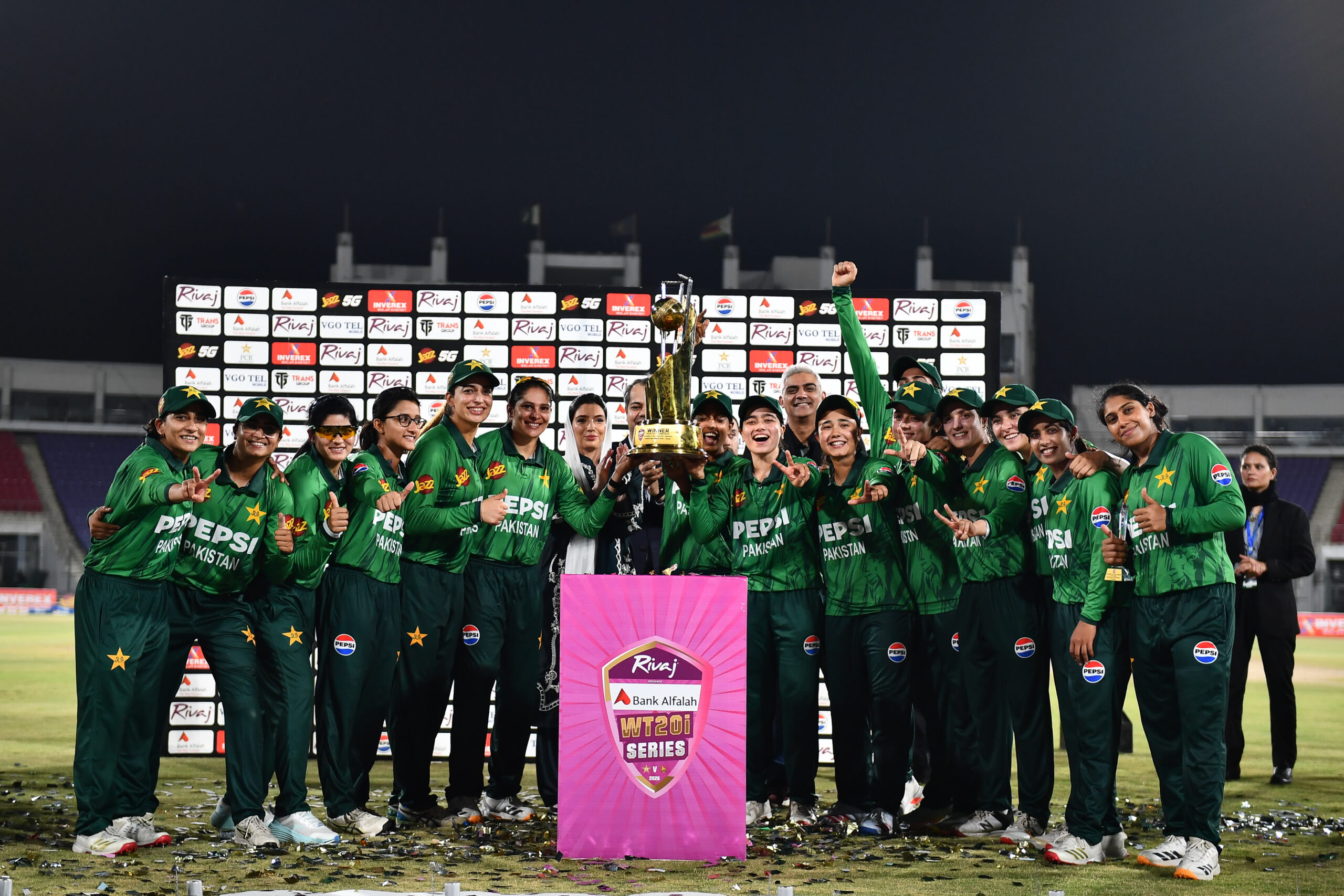
A captain for the ages with Fatima’s 15-ball blitz
As Pakistan complete whitewash over Zimbabwe, captain’s record-breaking form raises hopes for England showpiece
Asher Butt
The numbers are absurd. Unbeaten 62 off 19 balls. A fifty in 15 deliveries – the fastest in women’s T20 international history. Ten fours, two sixes, and a strike rate of 326.31. But the statistics, as staggering as they are, tell only part of the story. What Fatima Sana produced at the National Bank Stadium on the night of May 16, 2026, was not merely an innings. It was a statement. A declaration. A warning to every team in her path as Pakistan prepares for the ICC Women’s T20 World Cup in England.
Pakistan’s 3-0 T20I sweep over Zimbabwe – completing a dominant 6-0 victory across ODIs and T20Is – was expected. The margin of victory, however, was not. A 133-run demolition in the final T20I, following a 67-run win and a record-shattering 153-run rout in the series opener, underscored a team hitting its peak at precisely the right moment. But the series was never really about Zimbabwe. It was about preparation, about momentum, and about discovering whether Pakistan’s promising young core could translate domestic dominance into international performance. The answer, emphatically delivered, is yes.
The innings That redefined finishing
Fatima walked to the crease in the 16th over with Pakistan already well placed at 152 for 4. What followed defied convention. She struck boundaries from her first delivery, treating Zimbabwe’s bowlers with a contempt usually reserved for club attacks. The 19th over yielded 24 runs. The milestone arrived in the penultimate over – a 15-ball fifty that broke the previous women’s T20I record of 18 balls jointly held by Sophie Devine, Phoebe Litchfield, and Richa Ghosh.
Comparisons to Shahid Afridi’s swashbuckling style were inevitable and, in this case, apt. Fatima’s innings was not reckless; it was surgical. Every shot was deliberate, every boundary a product of impeccable timing and placement. She finished with 62 not out off 19 balls, her unbeaten 71-run partnership with Saira Jabeen (50 off 32) coming off just 22 deliveries.
The context matters. This was not a slog against a hapless attack; this was a captain leading from the front, demonstrating the kind of finishing firepower that Pakistan has historically lacked. In Fatima Sana, Pakistan may have finally found their version of Australia’s Ellyse Perry or England’s Nat Sciver-Brunt – a player who can win matches with bat, ball, and leadership.
A series of milestones
The opening T20I had already hinted at what was to come. Ayesha Zafar’s unbeaten 102 off 47 balls – the joint-third fastest century in women’s T20 internationals – powered Pakistan to 237 for 5, their first-ever total beyond 200 in the format. The 153-run victory margin was Pakistan’s largest in WT20I history, surpassing a 147-run win against Malaysia in 2018. Zimbabwe were bundled out for 84, with Fatima claiming 3 for 7 to overtake Asmavia Iqbal as Pakistan’s leading pace bowler in the format.
The second T20I offered a different kind of lesson. Pakistan were in trouble at 46 for 3 in the eighth over when 21-year-old Eyman Fatima walked to the crease. She was 2 off 9 balls before exploding into life, adding 77 runs off her next 34 deliveries to finish with 79 not out off 43 balls. Her maiden international fifty – reached off 32 balls – was a masterclass in rebuilding under pressure, and her unbroken 78-run partnership with Natalia Pervaiz (24 off 19) came off just 40 balls.
The series showcased Pakistan’s batting depth in ways rarely seen before. Ayesha Zafar (45 off 28 in the final T20I), Gull Feroza (37 off 19 in the opener), Aliya Riaz (48 off 23), Muneeba Ali, and Iram Javed all contributed meaningful innings. Five different players scored half-centuries or better across the three matches. This is not a team reliant on a single star; this is a team with options, with flexibility, with the capacity to absorb early setbacks and still post imposing totals.
The bowling: Spin dominance and captaincy control
Pakistan’s bowling was equally impressive, though it received less attention. Zimbabwe were dismissed for 84, 103 for 8, and 90 across the three matches – never once threatening the totals posted. Left-arm spinners Sadia Iqbal (3 for 20 in the final T20I) and Nashra Sundhu (2 for 21) shared wickets throughout the series, while Tuba Hassan and Rameen Shamim bowled with discipline.
Fatima Sana’s captaincy deserves particular mention. Her decision to bat first in all three matches – and to give her bowlers a total to defend – reflected a tactical clarity that has sometimes eluded Pakistan in previous tournaments. She rotated her bowlers intelligently, identified match-ups, and maintained pressure even when Zimbabwe’s openers threatened early boundaries.
The World Cup squad: Youth served, experience honored
The timing of the squad announcement – immediately following the series – was deliberate. The PCB named a 15-member World Cup squad that blends experienced campaigners with five debutants: Eyman Fatima, Natalia Pervaiz, Rameen Shamim, Saira Jabeen, and Tasmia Rubab will all make their maiden appearances at an ICC Women’s T20 World Cup.
Fatima Sana, 24, will captain Pakistan at her third World Cup and for the second successive edition. She is joined by veterans Aliya Riaz, Diana Baig, Nashra Sundhu, and Sadia Iqbal – players who have seen the highs and lows of international cricket and will provide the steadying influence that young squads require.
The reserves list is equally revealing: Sadaf Shamas, who scored 289 runs in the ODI series, finds herself on the sidelines, a reflection of the batting depth now available to selectors. Sidra Amin, another ODI star, is also in the reserves. The message is clear: form in the longer format does not guarantee T20 selection. Performance across formats, and the specific skills required for English conditions, have been prioritized.
The road ahead: Dublin, Derby, and Edgbaston
Pakistan will travel to Dublin for a tri-series against Ireland and West Indies from May 28 to June 4 – four matches that will serve as final match practice before the World Cup. Two warm-up fixtures in Derby – against Sri Lanka (June 6) and Scotland (June 9) – will allow further fine-tuning.
Then comes the main event. Pakistan’s World Cup campaign begins at Edgbaston on June 14 against arch-rivals India – a fixture that transcends sport. It is followed by matches against South Africa (June 17, Edgbaston), Bangladesh (June 20, Hampshire Bowl), Australia (June 23, Headingley), and Netherlands (June 27, Bristol County Ground).
The group is challenging. Australia are the defending champions and perennial favorites. India and South Africa possess world-class match-winners. Bangladesh have improved dramatically in recent years. There are no easy matches.
A balanced assessment
The Zimbabwe series was necessary but insufficient as a true test. Zimbabwe are ranked outside the top 10 in women’s T20Is, and their bowling attack lacked the pace and variation to trouble Pakistan’s batters consistently. The true measure of Pakistan’s progress will come against India, Australia, and South Africa – teams with deep batting lineups, multiple bowling options, and the experience of winning major tournaments.
Fatima’s 15-ball fifty, for all its brilliance, came against an attack that had already conceded 150 runs. Ayesha Zafar’s century was compiled on a flat Karachi pitch against a Zimbabwean side that had never toured Pakistan before. These achievements should be celebrated but also contextualized.
What the series did, unequivocally, was build confidence. Pakistan’s batters now believe they can score 200. Their bowlers believe they can defend any total. And Fatima Sana has demonstrated that she possesses the rare ability to single-handedly change the course of a match – a quality that separates good teams from championship teams.
The verdict is that Pakistan enters the Women’s T20 World Cup with genuine optimism for the first time in years. The batting lineup has depth and power. The spin attack is among the best in Asia. The captain is in the form of her life. And the team has just completed a double whitewash – albeit against inferior opposition – with a level of dominance that leaves no room for doubt about their readiness.
The true test awaits in England. But if Fatima Sana’s 15-ball fifty taught us anything, it is that this Pakistan team no longer fears the big stage. They are coming to win.