Asher Butt
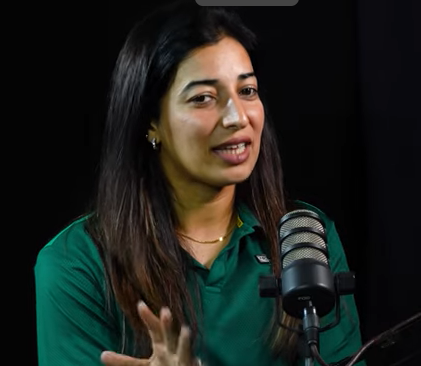
Dynamic Pakistan women’s all-rounder Aliya Riaz has never been one to shy away from hard work, but even by her own high standards, the past few months have pushed limits—physically, mentally and professionally. Speaking in a candid podcast interview, Aliya opened up about her personal life, a grueling high-performance fitness camp, Pakistan’s recent international outings, and the team’s preparations for the ICC Women’s T20 World Cup 2026.
From marriage into a cricketing household to surviving what she jokingly described as a “bootcamp tougher than Kakul,” Aliya’s journey reflects a player evolving with the modern demands of the game.
A career built on consistency
Aliya’s international journey began in August 2014, when she earned her 30th T20I and 71st ODI cap for Pakistan. Over more than a decade, she has grown into one of the team’s most reliable batters and utility players, featuring in 81 Women’s ODIs and 102 Women’s T20Is. Her numbers underline her value—1,620 runs in WODIs, 1,202 runs in WT20Is, along with 32 wickets across formats.
Yet, statistics only tell part of the story.
Marriage, balance and a cricket-centric home
Aliya recently entered a new phase of life after marrying Ali Younas, a cricket commentator and the brother of legendary fast bowler Waqar Younas. She credits her smooth transition to married life to the support of her husband and his cricketing background.
“Marrying into a cricket family made things easier,” she shared. “Ali understands the demands of the game completely and has been incredibly supportive.”
With a laugh, she added that her husband is the “laadla” of his family. “He’s pampered by his mother, aunts and sisters—now I have to deal with all his tantrums,” she joked.
Cricket, it seems, never leaves their home. The television is almost permanently tuned to a cricket channel, and conversations inevitably drift back to the sport. In an interesting coincidence, Aliya revealed that Ali had once commentated on one of her finest innings in South Africa—something she only discovered later while rewatching the footage.
Wahab Riaz’s no-nonsense fitness camp
The heart of the interview revolved around the recently concluded women’s skills and fitness camp, led by Senior Manager and Selector Wahab Riaz alongside the coaching staff. Aliya did not mince words when describing its intensity.
Running from 6am to 6pm, the camp featured strict diet plans, gym workouts, swimming sessions and relentless field drills. “It was tougher than the famous Kakul military training,” she said, smiling.
Mistakes were punished instantly. A dropped catch or any hint of “laziness” meant three immediate laps around the ground. Rest, meanwhile, was almost a forbidden word.
“If someone looked tired, Wahab bhai would ask if they wanted rest,” Aliya recalled. “If anyone said yes, he’d say, ‘Great, now play two matches back-to-back—you’ll feel better.’”
Having spent over ten years in international cricket, Aliya told younger players she had never experienced a camp of this magnitude. However, she firmly believes such discomfort was long overdue.
“These sessions broke our comfort zones—and that’s exactly what Pakistan women’s cricket needed to grow.”
Technical growth under the new coaching setup
Aliya also highlighted the impact of the revamped coaching staff, particularly batting coach Imran Nazir and bowling coach Umaid Asif.
Imran Nazir’s focus on power-hitting revolved around repetition and realism. Players hit over 100 balls daily using bowling machines in open grounds rather than confined nets, working on specific scoring zones. One day focused on fuller deliveries, another on pull shots and boundary-clearing options.
On the bowling side, Umaid Asif conducted targeted drills with pacers, while Abdul Rehman assisted the spinners with control and variations.
Preparing for new responsibility
Traditionally batting at No. 5 or 6, Aliya has taken a proactive step toward expanding her role. Reflecting on Pakistan’s campaign in the ICC Women’s Cricket World Cup 2025, she realized the importance of adaptability.
“If the top order collapses, I need to be technically ready to face the new ball,” she explained. She is now practicing against swing and pace in the opening overs—preparing herself for any situation the team may need her in.
How the game has changed
Aliya’s reflections on the evolution of women’s cricket in Pakistan are striking. When she began her journey, awareness was minimal.
“In 2010, I didn’t even know Pakistan had a women’s team,” she recalled, until she watched Sana Mir win Asian Games gold.
Facilities were scarce, domestic matches were limited, and access to grounds was a constant struggle. Fast forward to today, and the landscape looks vastly different—36-player pools, college scholarships for women cricketers, and regular televised matches.
She also praised emerging talent, naming players like Hamna and Saira, and noting Hamna’s remarkable fitness transformation to meet international demands.
Eyes on South Africa and the World Cup
Looking ahead, Aliya is eager to translate preparation into performance. Having previously scored an 80-plus knock in South Africa, she has set herself a personal target for the upcoming tour.
“This time, I’m aiming for a century,” she said with quiet confidence.
Beyond individual milestones, the ICC Women’s T20 World Cup 2026 looms large. The goal is clear—to reach the semi-finals and beyond.
“T20 is a format where any team can cause an upset on their day,” Aliya said. “We want to cross that line this time.”
With renewed fitness standards, technical clarity and growing belief, Aliya Riaz and Pakistan women’s team appear determined to turn promise into progress—one hard-earned step at a time.